
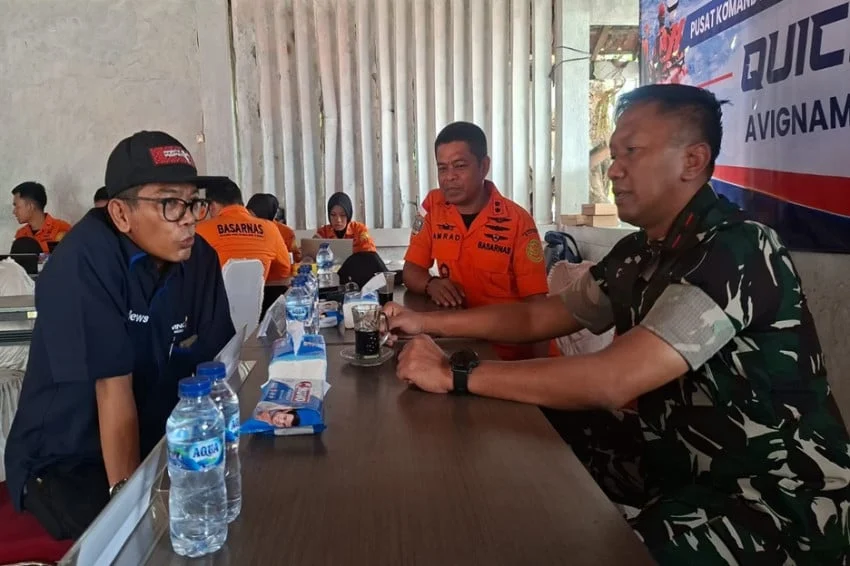
The atmosphere at the Joint Search and Rescue (SAR) Post located at Carita Beach, Pandeglang, Banten, remains somber yet resolute as the intensive operation to locate five journalists and three crew members missing in the Sunda Strait enters its second week. On Monday, September 14, 2026, Lukman Hanafi, Head of News Gathering at iNews Media Group, arrived at the command center to express official gratitude and provide moral support to the multinational and multi-agency teams working under challenging maritime conditions.
The visit served as a critical touchpoint between media leadership and the field commanders, including Banten Search and Rescue Office Head Al Amrad and Danrem 064/Maulana Yusuf Brigadier General TNI Daru Cahyadi Soeprapto. The gathering also included key stakeholders such as Banten Governor Andra Soni and Polda Banten Head of Public Relations Senior Commissioner Maruli Ahiles Hutapea, underscoring the high-level coordination required for a search operation of this magnitude.
Chronology of the Incident and Search Operations
The ordeal began when communication was lost with a vessel carrying a team of media professionals and boat crew members while navigating the volatile waters of the Sunda Strait. The region, known for its complex underwater topography, unpredictable currents, and heavy maritime traffic, has posed significant challenges for rescue divers and surface vessels since the initial distress signal was triggered.
Following the initial loss of contact, the National Search and Rescue Agency (Basarnas) launched an expansive operation covering a wide radius from the last known coordinates. By the seventh day of the operation, the search radius had been expanded and recalibrated, with tactical operations shifting to be centered from the Pelindo Cilegon Port. This strategic move was designed to optimize the deployment of fast-response boats and specialized equipment capable of navigating the deeper, more turbulent sections of the strait.
The operation has been characterized by a multi-agency approach. Aside from Basarnas, the mission involves personnel from the Indonesian Navy (TNI AL), the Indonesian National Police (Polri), local disaster mitigation agencies (BPBD), and specialized maritime rescue units. Despite the mobilization of advanced sonar technology and aerial surveillance, the extreme weather patterns prevalent in the Sunda Strait during this season have frequently hampered visibility and hampered underwater recovery efforts.
The Human Element: Standing with Families
Beyond the tactical briefings and strategic assessments, the visit by Lukman Hanafi highlighted the human toll of the disaster. During his time at the command post, Hanafi met with Juliasih, the mother of Yudistiro Pranoto, one of the iNews Media Group journalists currently missing. The presence of families at the SAR post reflects the agonizing wait for news that defines the current phase of the mission.
Hanafi expressed the company’s unwavering commitment to supporting the families of the victims. "We are here to ensure that the search teams know their efforts are deeply valued and to reassure the families that we are doing everything in our power to support the authorities in this critical mission," Hanafi stated. The emotional weight of the situation remains a primary concern for the coordinating agencies, who have provided psychosocial support to the families gathered in Pandeglang.
Official Response and Extension of Search Efforts
In a recent development, authorities confirmed that the search and rescue operation has been extended for an additional three days. This decision was reached following a rigorous evaluation of the mission’s progress and the identification of new potential drift patterns based on current oceanic data.
"The extension of the search window is not merely a procedural decision; it is a commitment to the families and the institutions involved," noted Al Amrad, Head of the Banten Search and Rescue Office. He emphasized that the search strategy is constantly evolving, incorporating satellite imagery, current modeling, and expert input from maritime meteorologists to narrow the probability of location.
Danrem 064/Maulana Yusuf, Brigadier General Daru Cahyadi Soeprapto, echoed these sentiments, highlighting the synergy between military and civilian assets. "Our soldiers are working alongside Basarnas and local police to ensure no stone is left unturned. We are utilizing every resource at our disposal, from aerial patrols to specialized dive teams, to cover the identified sectors as thoroughly as possible," he explained.
Data and Environmental Challenges in the Sunda Strait
The Sunda Strait is one of the most vital yet treacherous shipping lanes in the Indonesian archipelago. Connecting the Java Sea to the Indian Ocean, it is subject to the influence of the Indonesian Throughflow (ITF), which creates strong, shifting currents that can displace objects or persons far from their initial point of disappearance in a matter of hours.
Environmental data provided by the Meteorology, Climatology, and Geophysics Agency (BMKG) indicates that wave heights in the search zone have fluctuated between 1.5 to 2.5 meters throughout the week, occasionally spiking due to sudden atmospheric pressure changes. These conditions require the use of high-endurance vessels and specialized diving equipment that can withstand the high-pressure environment of the strait’s deeper trenches.
The reliance on the Pelindo Cilegon Port as a primary logistics hub has significantly increased the efficiency of refueling and crew rotation, allowing the SAR teams to maintain a 24-hour presence in the operational area. The deployment of remotely operated vehicles (ROVs) has also been prioritized, particularly in zones where the depth exceeds the safe limits for human divers, ensuring that the search remains comprehensive even under hazardous conditions.
Broader Implications for Maritime Safety and Media Operations
The disappearance of the journalists has prompted a wider discussion regarding the protocols for media coverage in hazardous environments. Industry experts have noted that the incident underscores the inherent risks faced by journalists and media crews who operate in maritime zones for news gathering.
"The safety of our personnel is paramount," said a representative from the media industry during a press briefing. "This event serves as a somber reminder that the pursuit of truth and information often carries physical risks, and the coordination between media organizations and maritime authorities must be refined to ensure better safety protocols in the future."
The incident has also highlighted the necessity for increased maritime surveillance and emergency response capabilities in the Sunda Strait. As a critical economic artery for Indonesia, the strait’s safety infrastructure is under constant pressure to manage both commercial shipping and emergency search operations. Analysts suggest that the ongoing search may lead to a review of standard operating procedures for small craft navigating these waters, particularly during periods of high environmental instability.
Conclusion: A Continued Vigil
As the clock ticks into the extended period of the search, the collaborative effort between the iNews Media Group, the local government of Banten, and the various rescue agencies remains steadfast. The goal remains clear: to bring the missing journalists and crew home.
The dedication shown by the rescue personnel, who continue to brave the unpredictable elements of the Sunda Strait, has earned the respect of both the public and the media industry. For now, the Posko SAR Gabungan remains the center of gravity for this operation, a site of hope and intense professional rigor. The nation continues to monitor the situation, waiting for updates from the field, while families hold onto the hope that the exhaustive search efforts will soon yield a breakthrough.
The commitment from both the military and the local government, as evidenced by the high-level meeting on Monday, ensures that the search is not merely a routine operation but a prioritized mission of national importance. As the operation continues, the focus will remain on precision, persistence, and the collective resolve to address the tragedy in the Sunda Strait with the full weight of the resources available.
