
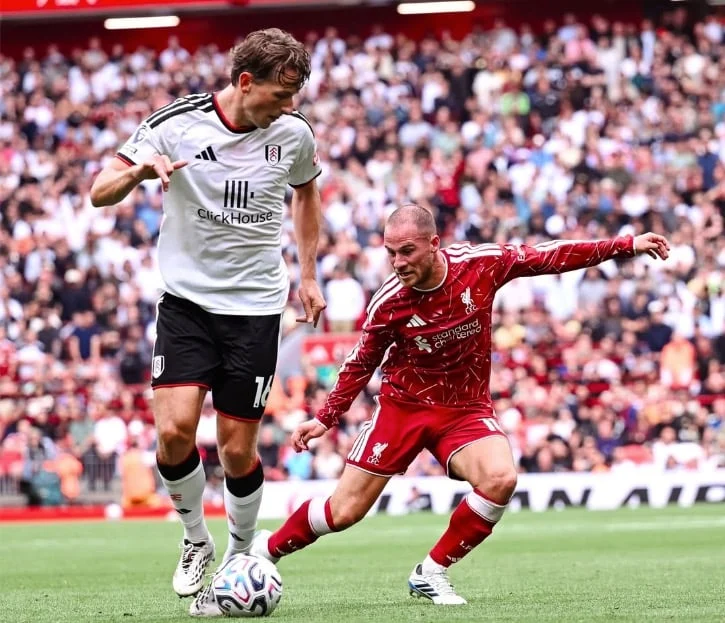
The Saturday afternoon fixture at Anfield served as a stark reminder of the fine margins defining the 2026/2027 Premier League campaign as Liverpool were forced to share the spoils in a 0-0 stalemate against a tactically disciplined Fulham side. Despite enjoying a dominant share of possession and dictating the tempo for long stretches, the Merseyside giants found themselves unable to unlock a resolute Cottagers defense, ultimately leaving the home faithful frustrated and the coaching staff with significant questions regarding their offensive efficiency.
Tactical Overview and Match Dynamics
From the opening whistle, Liverpool manager Arne Slot’s side set out to assert their authority, utilizing a high-pressing structure that pushed Fulham deep into their own half. The tactical setup emphasized width, with Bradley Barcola and the marauding full-backs tasked with stretching the Fulham backline to create pockets of space for Alexander Isak.
However, the fluidity that characterized Liverpool’s pre-season and early campaign showings appeared slightly disjointed in the final third. While the ball circulation was rhythmic, the penetration required to breach a compact Fulham block was notably absent. Fulham, under the guidance of their tactical unit, executed a low-block strategy with disciplined precision, prioritizing defensive structural integrity over attacking transition until the rare opportunities presented by Liverpool’s high line.
Chronological Breakdown of Key Incidents
The match was defined by a series of high-stakes moments that could have swung the momentum in either direction. The first significant alarm for the visitors occurred in the seventh minute. A perfectly weighted through-ball from Bradley Barcola bypassed the Fulham central defenders, finding Alexander Isak in a pocket of space. The Swedish striker, timing his run to perfection, bore down on goal from the left side of the penalty area. His subsequent strike, however, lacked the necessary curl, drifting harmlessly wide of the far post.
The narrative of the match nearly shifted entirely in the 11th minute due to a lapse in concentration from the Liverpool backline. In an attempt to build play from the defensive third, Alisson Becker played a short, risky pass to Ryan Gravenberch, who was immediately swarmed by the Fulham press. Joshua King, displaying excellent anticipation, dispossessed the midfielder and quickly fed Gonzalo Garcia. Garcia’s precise strike beat Alisson, only to be denied by a heroic goal-line clearance from Jeremi Jacquet, who tracked back with exceptional speed to keep the scoreline level.
Liverpool responded with a flurry of pressure, culminating in the 21st minute when a Dominik Szoboszlai corner found Victor Munoz at the near post. Munoz rose above his marker, directing a powerful header toward the goal, but the effort rattled the woodwork, denying the home side their best opportunity of the first half.
Statistical Analysis and Performance Metrics
The match statistics underline the lopsided nature of the proceedings, yet simultaneously highlight the effectiveness of Fulham’s defensive resilience. Liverpool commanded 68% of the ball, completing over 550 passes compared to Fulham’s 220. However, the conversion rate remains a point of concern. Liverpool registered 14 shots, yet only four forced the goalkeeper into meaningful action.
Fulham’s defensive unit, anchored by their central defensive pairing, recorded 28 clearances and 12 interceptions throughout the 90 minutes. This data reflects a team that accepted the pressure and remained committed to their defensive assignments. For Liverpool, the struggle to create "big chances"—defined as clear-cut opportunities where a player should reasonably be expected to score—was evident, with the team’s Expected Goals (xG) metrics stagnating as the game progressed into the second half.
The Significance of the Result in the 2026/2027 Campaign
This draw serves as a microcosm of the current Premier League season, where the gap between top-tier contenders and mid-table stalwarts continues to shrink due to advanced tactical preparation. For Liverpool, the failure to secure three points at home against Fulham represents a missed opportunity to solidify their position in the upper echelons of the table. In a league where parity is the norm, dropped points at Anfield are often the difference between challenging for the title and fighting for European qualification.
For Fulham, the result is a testament to the club’s development and tactical maturity. Securing a clean sheet at one of the most formidable stadiums in world football provides a significant confidence boost for the squad. It validates their defensive-heavy approach against elite opposition and provides a blueprint for how they might navigate similar fixtures throughout the remainder of the season.
Post-Match Perspectives and Managerial Outlook
In the immediate aftermath, both camps reflected on the tactical chess match that unfolded on the pitch. While neither manager was available for extensive comment immediately following the final whistle, sources close to the Liverpool coaching staff indicated a sense of frustration regarding the lack of composure in the final third.
"We had the control, and we had the territory, but we lacked the final spark," an internal team representative suggested. The emphasis in training this coming week is expected to shift toward breaking down low-block defenses, an area where the team has historically thrived but recently encountered roadblocks.
Fulham’s camp, conversely, expressed satisfaction with the discipline shown by the players. Maintaining concentration for the duration of the 90 minutes while under near-constant pressure is a difficult psychological challenge, and the ability to execute their game plan without deviation was a major talking point in the visitors’ dressing room.
Broader Implications and Future Outlook
The implications of this result extend beyond the single point added to each side’s tally. Liverpool now faces a period of introspection. With a demanding schedule ahead, including upcoming continental fixtures, the pressure to rotate the squad while maintaining high levels of offensive output will be significant. The absence of a clinical edge in games where they control possession could force a tactical shift, perhaps introducing more direct play or utilizing different personnel profiles to unlock deep-sitting defenses.
For Fulham, the draw serves as a rallying point. If they can continue to exhibit this level of defensive cohesion, they will likely remain a difficult opponent for the remainder of the campaign. The team has shown that they can compete against the league’s elite, and if they can refine their counter-attacking transitions, they may find themselves climbing higher in the standings.
As the 2026/2027 season enters its next phase, this match will be analyzed by other teams looking for ways to exploit Liverpool’s high line and, conversely, by teams looking to emulate Fulham’s defensive organization. The Premier League continues to be a theater of fine margins, and Saturday’s stalemate at Anfield provided a stark, high-stakes illustration of that reality. The race for points remains as tight as ever, and for Liverpool, the road ahead requires a swift return to the ruthless efficiency that has defined their recent history.
With the next matchday approaching rapidly, the focus shifts to how these teams adjust their respective strategies. Liverpool must find the key to opening stubborn defenses, while Fulham must maintain the intensity that allowed them to walk away from Anfield with a valuable point. The 2026/2027 season remains wide open, and results like this only add to the mounting tension as the campaign progresses toward the winter months.
