
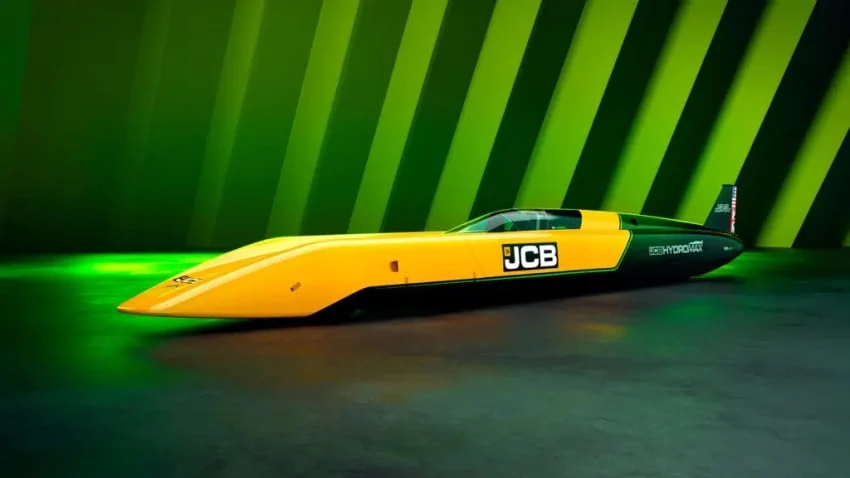
The iconic British engineering firm, JCB, is poised to etch its name in the annals of speed history once again, announcing its ambitious endeavor to shatter the world land speed record with the unveiling of Hydromax, a specially engineered hydrogen-powered machine. The target venue for this groundbreaking attempt is the legendary Bonneville Salt Flats in the United States, a proving ground for automotive speed that has witnessed countless records being set and broken. This monumental project marks a significant return to the salt flats for JCB, nearly two decades after their previous triumph with the Dieselmax in 2006, a machine that achieved a blistering speed of 350.092 mph (563 km/h) powered by a conventional diesel engine.
The previous record-setting campaign saw Andy Green, a Royal Air Force pilot, at the helm of the JCB Dieselmax. Green, a man already etched in the history books as the first and only individual to break the sound barrier on land, is once again partnering with JCB for this new assault on speed. This time, he will pilot the Hydromax, a formidable machine measuring an impressive 32 feet in length, which is propelled by a revolutionary hydrogen-powered internal combustion engine. This choice of propulsion technology immediately sets JCB apart from many other manufacturers exploring alternative energy sources for high-performance applications.
A Unique Approach to Hydrogen Propulsion
While a growing number of automotive and engineering companies are focusing on fuel cell technology for hydrogen-powered vehicles, JCB has opted for a distinct and potentially more robust pathway by utilizing a hydrogen internal combustion engine. This approach leverages the fundamental principles of conventional internal combustion engines but has been meticulously adapted to run on hydrogen as its primary fuel source. According to JCB, this methodology is particularly well-suited for heavy-duty applications, as it retains the familiar characteristics and reliability of traditional engines while offering a practical and durable power solution.
The development of the Hydromax is the culmination of five years of intensive research and development, backed by a substantial investment estimated at £100 million (approximately RM640 million). This significant financial commitment underscores JCB’s dedication to pushing the boundaries of engineering and exploring cutting-edge sustainable technologies. The Hydromax is equipped with two hydrogen engines, each based on units derived from real-world production models. These engines, when combined, are engineered to deliver an astonishing aggregate power output of around 1,600 horsepower. This immense power, harnessed through innovative engineering, is crucial for overcoming the immense forces and challenges associated with achieving record-breaking speeds on the salt flats.
The Legacy of Speed at Bonneville Salt Flats
The Bonneville Salt Flats, located in Utah, USA, is more than just a vast expanse of salt; it is a historical monument to human ambition and mechanical ingenuity. For over a century, this unique geological formation has served as the ultimate testing ground for those who dare to challenge the limits of velocity. Its exceptionally flat and smooth surface, stretching for miles, provides the ideal environment for achieving extreme speeds with minimal friction. The salt flats became a popular venue for speed record attempts in the early 20th century, attracting a diverse range of competitors, from pioneering aviators and motorcyclists to automotive manufacturers and independent engineers.
The inherent challenges of Bonneville are as legendary as its successes. Competitors must contend with the harsh desert environment, including extreme temperatures and unpredictable wind conditions. The sheer speed involved necessitates meticulous attention to aerodynamics, tire technology, and vehicle stability. The history of Bonneville is punctuated by daring runs, spectacular failures, and ultimate triumphs, with each record set contributing to the ongoing narrative of human-machine synergy in the pursuit of ultimate speed.
A Chronicle of JCB’s Speed Aspirations
JCB’s foray into the realm of speed records is not a new phenomenon. The company’s history is punctuated by a clear desire to showcase the power and reliability of its engineering prowess on the world stage. The success of the JCB Dieselmax in 2006 was a landmark achievement, demonstrating the capability of diesel technology to achieve speeds previously thought unimaginable. The development of the Dieselmax was itself a testament to JCB’s commitment to innovation, with the machine featuring a highly modified 7.2-liter, six-cylinder diesel engine that was significantly uprated from its standard road-going counterpart. The engine was twin-turbocharged and intercooled, generating an impressive 750 hp.
The 2006 record was not merely about brute force; it was a carefully orchestrated engineering feat. The Dieselmax was designed with a low-drag, aerodynamic profile to minimize air resistance at extreme velocities. The tires were specially developed to withstand the immense centrifugal forces. The entire operation required a dedicated team of engineers and technicians working tirelessly to ensure the vehicle’s performance and safety. Andy Green’s piloting skill was, of course, paramount, requiring immense concentration and precision. His ability to control a vehicle traveling at such speeds, while maintaining a straight trajectory on the vast salt surface, is a testament to his exceptional talent and courage.
The Hydromax: A New Era of Hydrogen Power
The Hydromax represents a significant evolution in JCB’s pursuit of speed and technological advancement. The decision to employ a hydrogen internal combustion engine, rather than a fuel cell, is a strategic one. Fuel cells generate electricity through an electrochemical reaction, offering zero tailpipe emissions. However, internal combustion engines, when adapted for hydrogen, can offer certain advantages in terms of power delivery and potentially robustness for extreme applications. The combustion of hydrogen produces water vapor as a byproduct, which is significantly cleaner than the emissions from traditional fossil fuels.
JCB’s rationale behind this choice likely stems from their extensive experience with internal combustion engines in their vast product range, which includes excavators, loaders, and agricultural machinery. By modifying this existing technological foundation, they can potentially achieve a more immediate and predictable power output, which is critical for a land speed record attempt. Furthermore, the infrastructure for hydrogen refueling, while still developing, is becoming more accessible, making the operation of such a vehicle more feasible.
The dual-engine configuration of the Hydromax, producing approximately 1,600 hp combined, is a substantial leap from the Dieselmax’s 750 hp. This increased power output is necessary to overcome the exponentially increasing aerodynamic drag at higher speeds. As a vehicle’s speed doubles, its aerodynamic drag increases by a factor of four. Therefore, achieving speeds beyond the Dieselmax’s record will require a significant increase in power.
Supporting Data and Technical Specifications (Inferred and Contextual)
- Target Speed: While not explicitly stated, the aim is to surpass the existing record of 350.092 mph (563 km/h). Records in the realm of 400-500 mph are often targeted in these attempts, depending on the category.
- Engine Type: Two hydrogen-powered internal combustion engines, based on production units.
- Combined Power Output: Approximately 1,600 hp.
- Vehicle Length: 32 feet.
- Development Investment: £100 million (approximately RM640 million).
- Development Time: Five years.
- Previous Record Holder (JCB Dieselmax): 350.092 mph (563 km/h) in 2006.
- Previous Record Holder Pilot: Andy Green.
- Venue: Bonneville Salt Flats, Utah, USA.
Analysis of Implications and Future Prospects
JCB’s commitment to this ambitious project carries significant implications beyond the pursuit of a speed record. Firstly, it serves as a powerful demonstration of the potential of hydrogen as a viable fuel for high-performance internal combustion engines. In an era where the automotive industry is rapidly transitioning towards electrification, JCB’s work highlights that alternative pathways for decarbonization and high-power applications still exist. This could inspire further research and development into hydrogen ICE technology for niche applications, such as heavy-duty transport, motorsport, and specialized industrial equipment.
Secondly, the Hydromax project underscores JCB’s position as a leader in engineering innovation. By investing substantial resources into cutting-edge technologies and undertaking high-profile challenges, JCB reinforces its brand image as a forward-thinking and technologically advanced company. This can have a positive impact on its market perception and attract top engineering talent.
The success of the Hydromax at Bonneville would not only add another chapter to JCB’s illustrious history but also contribute to the broader understanding and acceptance of hydrogen-powered internal combustion engines. It represents a bold step into a future where sustainable fuels can coexist with high-performance applications, challenging conventional wisdom and pushing the boundaries of what is currently considered possible. The world will be watching with anticipation as Andy Green and the JCB Hydromax take to the salt flats, aiming to rewrite the record books once more.
