
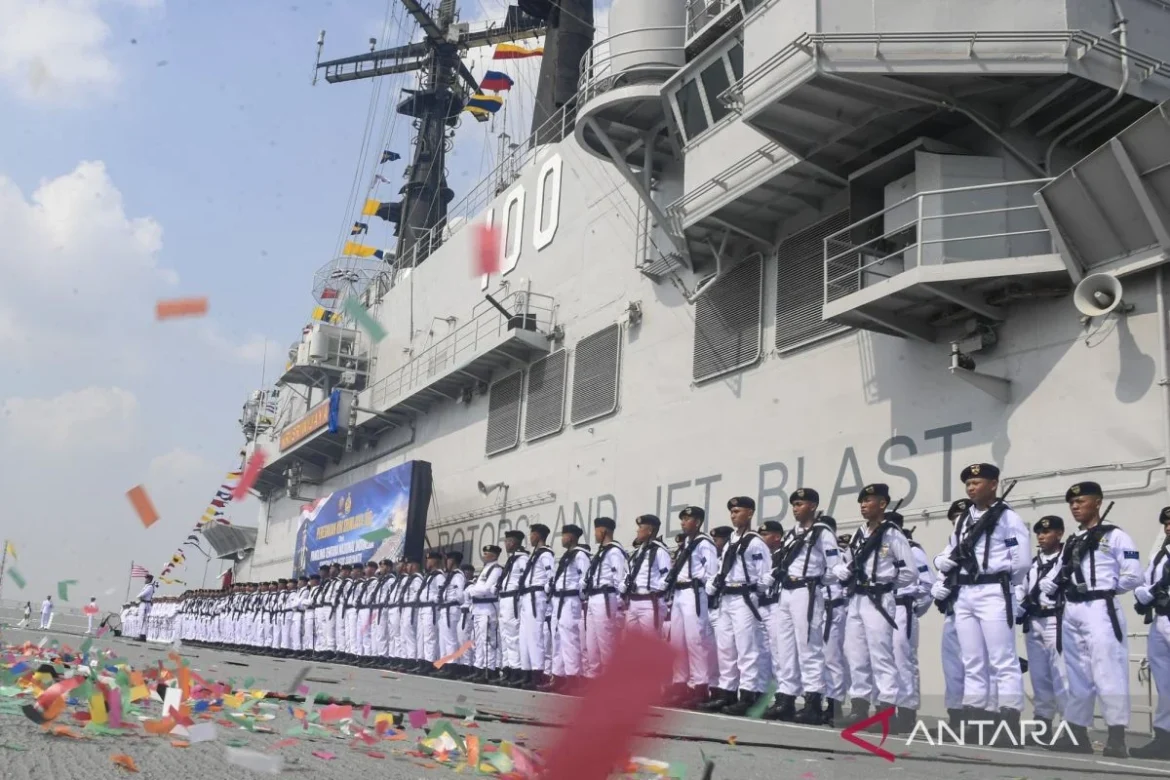
Jakarta has marked a historic milestone in its maritime defense evolution with the arrival of the former Italian Navy aircraft carrier, the ITS Giuseppe Garibaldi (C551). Docking gracefully at Pier 107 of Tanjung Priok Port in North Jakarta on Friday, September 18, 2026, the arrival of the iconic vessel signals the dawn of a new era for the Indonesian Navy (TNI AL). As the nation prepares to officially commission the ship into its active fleet under the new designation KRI Sriwijaya, defense analysts, maritime strategists, and the general public have turned their attention to the profound strategic, tactical, and humanitarian implications of introducing a sovereign floating airbase to the archipelago.
The arrival of the vessel represents more than just a magnificent addition to the military hardware of Southeast Asia’s largest economy; it signifies a structural transformation in how the archipelagic state projects power, secures its vast maritime territories, and responds to natural disasters. With an official handover and flag-raising ceremony scheduled for September 24, 2026, at the same port facility, the Indonesian military is stepping into a specialized tier of naval capabilities previously reserved for a handful of global naval powers.
A Chronological Overview of the Transfer and Preparations
The journey of the Italian-built carrier to Indonesian waters is the culmination of extensive diplomatic engagements, technical inspections, and strategic planning between Jakarta and Rome. Preliminary discussions regarding the acquisition of the vessel began years prior, as the Indonesian Ministry of Defense sought to bolster its blue-water navy capabilities while modernizing its aging fleet architecture.
Following successful negotiations, the Italian government agreed to transfer the combat-proven vessel to Indonesia as part of a bilateral defense cooperation framework. The ship departed from Italy earlier this year, navigating thousands of nautical miles across multiple oceans before finally making its landmark appearance in Tanjung Priok Port on September 18.
The forthcoming transition sequence will reach its ceremonial peak on September 24, 2026, when the Italian tricolor is permanently lowered and replaced by the Indonesian Red and White flag. High-ranking diplomatic and military officials from both nations are slated to attend the momentous event. State Secretary officials have also confirmed that the President of the Republic of Indonesia will personally receive the high-level delegation from the Italian Navy to honor the defense partnership. Following the formal commissioning, the vessel will undergo comprehensive dockyard refits to adapt its mechanical and operational systems to the precise strategic doctrine of the Indonesian Armed Forces.
Unpacking the Blueprint: What Makes a True Aircraft Carrier?
The public debate ignited by the arrival of KRI Sriwijaya often blurs the lines between large naval support vessels and dedicated aircraft carriers. In naval architecture, size alone does not qualify a ship as a carrier. While amphibious assault ships and logistics vessels can carry helicopters, a true aircraft carrier is explicitly engineered around an aviation-centric operational concept.
At its core, an aircraft carrier functions as a mobile floating airfield. Unlike conventional surface combatants—such as frigates, corvettes, and destroyers—whose primary offensive and defensive capabilities rely on surface-to-surface missiles, naval artillery, and torpedoes, an aircraft carrier’s primary offensive and defensive punch is delivered from the skies via embarked aircraft.
The defining structural characteristics of the platform include a continuous or angled flight deck, sophisticated aircraft elevators, cavernous internal hangars for storage and maintenance, specialized aviation fuel storage depots, and advanced air-traffic control command centers. These integrated systems allow the vessel to launch, recover, service, and redeploy fixed-wing aircraft, vertical takeoff and landing (VTOL) jets, and rotary-wing assets thousands of miles away from traditional land-based runways.
Strategic Versatility: Beyond Combat Operations to Humanitarian Relief
While naval forces historically view aircraft carriers through the lens of power projection and fleet defense, the TNI AL has articulated a distinct, multifaceted doctrine for KRI Sriwijaya. Chief of Naval Staff Admiral Muhammad Ali emphasized that the vessel will be systematically optimized for Military Operations Other Than War (OMSO), with a heavy focus on HADR (Humanitarian Assistance and Disaster Relief) missions.
As an archipelagic nation spanning over 17,000 islands, Indonesia is uniquely vulnerable to natural disasters ranging from earthquakes and tsunamis to volcanic eruptions. When catastrophic events strike remote islands, traditional infrastructure such as bridges, roads, and regional airports is frequently compromised, cutting off vital lifelines for days or weeks.
In such critical scenarios, KRI Sriwijaya will serve as an invincible floating command center and logistical hub. Equipped with an expansive flight deck capable of operating multiple heavy-lift helicopters and advanced unmanned aerial vehicles (drones), the ship can deploy relief supplies, medical teams, and search-and-rescue units directly to the hardest-hit regions. The ship’s capacity to act as a self-sustaining medical and logistical base offshore ensures that disaster response remains unimpeded by damaged local infrastructure.
Technical Adaptations and the Future of Naval Aviation
The original design of the ITS Giuseppe Garibaldi reflected the specialized tactical needs of the Italian Navy, having successfully operated AV-8B Harrier II V/STOL (Vertical/Short Take-Off and Landing) strike fighters and anti-submarine warfare helicopters throughout its service life.
Upon entering Indonesian service, TNI AL leadership has outlined a tailored modernization program. While naval planners have expressed strong interest in acquiring modern V/STOL or short takeoff and vertical landing aircraft to maximize the ship’s tactical flexibility, the immediate focus remains on integrating heavy utility helicopters and reconnaissance drones. According to statements from naval headquarters, the integration of these systems will dramatically enhance maritime domain awareness across Indonesia’s Exclusive Economic Zone (EEZ).
Admiral Ali explained that the decision to select the name "Sriwijaya"—paying homage to the glorious ancient maritime empire that once dominated Southeast Asian trade routes—reflects the nation’s renewed aspirations as a dominant maritime power. The extensive engine overhauls and structural refits currently planned will ensure that the ship meets tropical operational standards and the specific endurance requirements mandated by Indonesian maritime patrols.
Implications for Regional Stability and Defense Posture
The integration of KRI Sriwijaya into the TNI AL marks a profound evolutionary leap for Indonesian defense strategy. For decades, Indonesia’s naval strategy has centered primarily on green-water defense and coastal patrols. The acquisition of a light aircraft carrier shifts operational horizons outward, facilitating true blue-water operational capability.
Defense analysts note that while the vessel is not intended to spark regional arms races, it undeniably elevates Indonesia’s standing within ASEAN and the broader Indo-Pacific security architecture. By possessing a mobile aviation platform, the Indonesian military gains an unprecedented force multiplier for protecting vital sea lanes of communication (SLOCs), securing territorial waters against illegal incursions, and projecting stability during regional crises.
As the Red and White flag prepares to rise over KRI Sriwijaya on September 24, 2026, Indonesia stands at the threshold of a new maritime epoch. Balancing traditional defense readiness with vital humanitarian utility, the nation’s first aircraft carrier is poised to become a symbol of national pride, technological advancement, and unyielding maritime sovereignty.
