
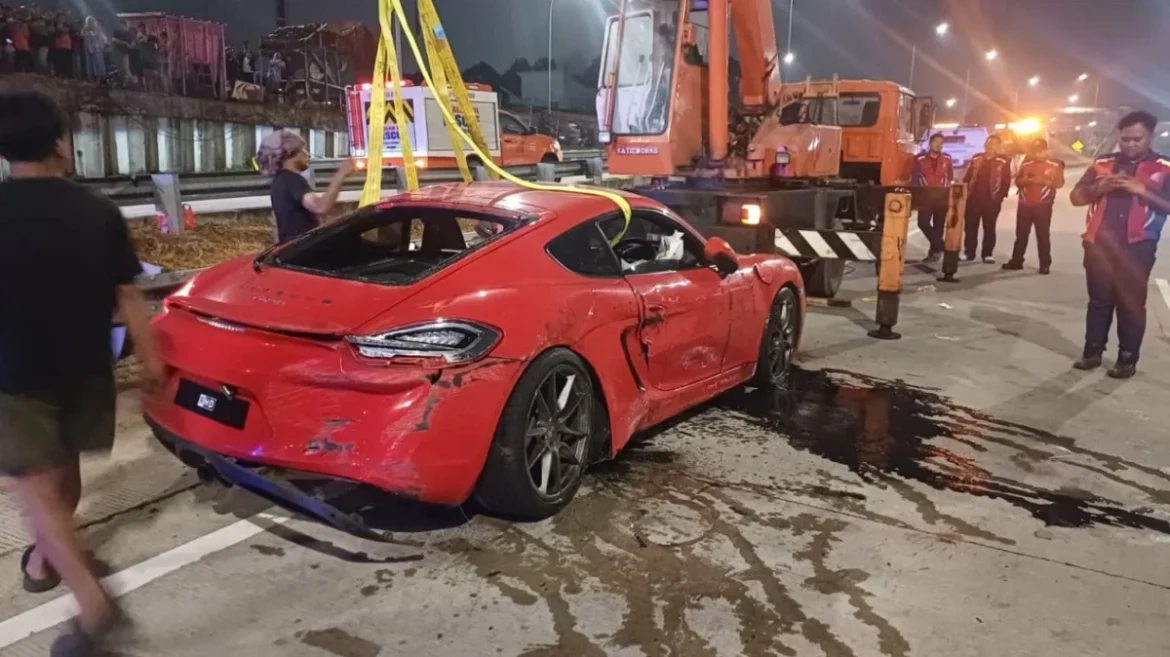
A red Porsche sports car was involved in a severe single-vehicle accident on the Depok-Antasari (Desari) Toll Road in Depok, West Java, on Saturday evening, September 19, 2026. The high-performance vehicle reportedly lost control after hydroplaning over a pool of standing water accumulated on the asphalt surface, subsequently slamming into the steel guardrail before plunging into a drainage ditch adjacent to the highway.
The incident, which occurred at approximately 6:45 PM local time, rattled motorists traveling along the busy corridor. Despite the dramatic nature of the crash and the extensive damage sustained by the luxury automobile, traffic authorities and emergency responders confirmed that no fatalities or injuries resulted from the accident. The swift response from highway patrol units ensured the wreckage was safely extricated from the scene, minimizing prolonged traffic congestion on the vital arterial toll road connecting southern Jakarta to Depok.
Chronology of the Incident on the Desari Toll Road
According to preliminary field reports gathered by highway authorities, the red Porsche—later identified as a mid-engine sports coupe—was navigating the Depok-Antasari Toll Road heading from Sawangan toward Antasari. The vehicle reached Kilometer 4+200, a stretch known for variable drainage conditions during inclement weather.
Earlier in the evening, moderate to heavy rainfall had swept across parts of Depok and South Jakarta, leaving patches of standing water on several sections of the relatively modern toll infrastructure. As the sports car approached the affected zone at highway speeds, the driver allegedly lost traction due to hydroplaning—a phenomenon where a layer of water builds between the tires of the vehicle and the road surface, leading to a loss of braking and steering control.
Unable to correct the trajectory, the vehicle veered sharply toward the left shoulder of the road. It forcefully impacted the metal guardrail, tearing through the protective barrier before dropping entirely into the concrete drainage canal running parallel to the toll road. The kinetic energy of the impact caused substantial structural deformation to multiple sections of the automobile, particularly impacting the front bumper, both lateral flanks, and the roof structure.

Vehicle Profile: Engineering and Performance Specifications of the Porsche Cayman 2.7 AT
A detailed inspection of vehicle registration data associated with the incident reveals that the wrecked automobile is a 2013 Porsche Cayman 2.7 Automatic (PDK), a model renowned within the automotive community for its precise handling and track-derived engineering.
The two-door sports coupe is powered by a naturally aspirated 2.7-liter (2,706 cc) flat-six boxer engine. Mounted centrally just behind the cabin—a layout known as a mid-engine configuration—the powerplant is optimized to achieve near-perfect weight distribution, enhancing cornering stability and agility compared to front-engine or rear-engine alternatives.
This engine configuration generates a maximum output of 275 horsepower and 290 Newton-meters of torque. Power is transmitted to the rear wheels via Porsche’s proprietary seven-speed dual-clutch transmission, widely celebrated as the Porsche Doppelkupplung (PDK). This transmission system allows for lightning-fast gear shifts without interrupting power delivery, enabling the Cayman 2.7 to accelerate from 0 to 100 kilometers per hour in approximately 5.5 seconds. Depending on aerodynamic configurations and final-drive specifications, the vehicle boasts a top speed of 266 kilometers per hour.
Despite its compact dimensions and strict two-seater layout, the Cayman incorporates dual luggage compartments—one located beneath the front hood and another behind the engine bay—maximizing utility without compromising its low-slung, aerodynamic silhouette. In terms of valuation, administrative tax data from the Jakarta provincial government pegs the base New Vehicle Selling Value (NJKB) of a 2013 Porsche Cayman 2.7 AT at approximately Rp899 million. However, automotive market analysts emphasize that this figure serves purely for regional tax calculation purposes and does not reflect actual open-market transaction prices for used luxury units, which fluctuate widely based on vehicle condition, mileage, and maintenance history.
Hydroplaning Risks and Infrastructure Safety on Urban Toll Roads
The unfortunate incident on the Desari Toll Road highlights broader safety concerns regarding vehicular operation during adverse weather conditions, particularly on high-speed urban toll networks. Hydroplaning remains one of the most hazardous phenomena faced by drivers of high-performance vehicles equipped with wide tires. Wide contact patches, while beneficial for dry-weather grip and cornering forces, inherently increase the risk of water displacement failure when encountering deep puddles at elevated speeds.
Road safety advocates and transportation experts frequently remind motorists that luxury sports cars equipped with rear-wheel-drive systems and sophisticated traction management require heightened driver attentiveness when road surfaces are compromised by standing water. Even advanced electronic stability control (ESC) systems can struggle to recover traction if the tires completely lose mechanical contact with the asphalt.

Concurrently, the incident has drawn renewed focus on the importance of proactive infrastructure maintenance. Effective drainage systems, regular clearing of debris from gutters, and proper surface grading to prevent water pooling are critical responsibilities for toll road operators. While unexpected downpours can temporarily overwhelm drainage capacity, ensuring rapid runoff is essential to mitigating the risk of hydroplaning-related accidents on high-speed corridors.
Official Responses and Preventive Measures
Following the extraction of the vehicle, traffic management teams from PT Citra Waspphutowa, the concessionaire operating the Desari Toll Road, coordinated with local traffic police to secure the accident site and conduct a formal investigation into the exact sequence of events. Authorities reiterated their commitment to maintaining road safety standards and urged motorists to adjust their driving behavior during wet weather conditions.
Law enforcement agencies and toll operators have consistently issued advisories urging drivers to reduce speed, increase following distances, and avoid sudden steering or braking maneuvers when navigating through wet or flooded road segments. Drivers of high-performance vehicles are particularly encouraged to monitor tire tread depth regularly, as worn tires significantly exacerbate the risk of losing control during hydroplaning events.
As urban centers across Indonesia continue to experience erratic weather patterns influenced by seasonal shifts, incidents of this nature serve as a stark reminder of the delicate balance between high-speed automotive engineering and environmental variables on public thoroughfares. Fortunately, the absence of casualties in Saturday’s crash averted a potential tragedy, leaving the event as a sobering case study on the perils of standing water and the unforgiving nature of high-speed transit.
