
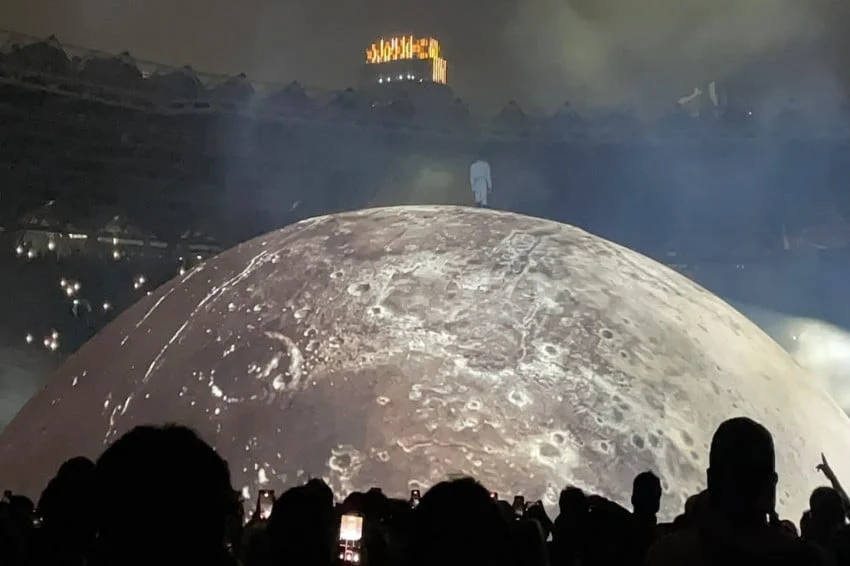
The night sky over Senayan in Central Jakarta bore witness to one of the most technologically ambitious and visually arresting live music productions in the history of Southeast Asian entertainment. American music icon Kanye West, professionally known as Ye, captivated tens of thousands of enthusiastic spectators at the Gelora Bung Karno Main Stadium (SUGBK) on Saturday evening, October 24, 2026. The concert, anchored by a colossal 360-degree dome stage positioned at the center of the stadium’s turf, combined cutting-edge projection mapping, minimalist theatricality, and a sweeping retrospective of West’s legendary discography.
For months, anticipation had reached a fever pitch across Indonesia and the wider region. The arrival of the controversial yet undeniably influential artist marked a major milestone for post-pandemic concert tourism in Jakarta. As the venue filled to capacity, industry observers, international critics, and local fans alike recognized that the performance would transcend a traditional concert, evolving instead into a grand-scale, immersive conceptual art installation.
The Evolution and Architecture of the Dome Stage
The focal point of the entire production was undoubtedly the massive, hemispherical Dome Stage. Standing imposingly on the green field of SUGBK, the structure functioned as both an architectural marvel and the primary canvas for the evening’s visual narrative. Unlike conventional concert setups that rely on flat LED backdrops and traditional proscenium arches, West’s production utilized a 360-degree configuration, ensuring that every spectator in the sprawling stadium maintained a direct line of sight to the performance center.
The dome was integrated with ultra-high-resolution projection mapping technology capable of transforming the physical structure into shifting celestial and terrestrial landscapes. Early in the performance, the dome projected a hyper-realistic view of planet Earth, displaying intricate, rotating details of blue oceans, swirling cloud cover, and distinct continental landmasses. This initial visual gave way to a dramatic and seamless spatial transition. Within moments, the vivid blues and greens of Earth dissolved into the stark, monochromatic expanse of the lunar surface.
The projection meticulously recreated the topography of the Moon, featuring hyper-detailed textures of impact craters, jagged ridges, and silver-gray shadows that shifted dynamically with the musical arrangements. Atop this artificial lunar zenith stood Kanye West himself. Dressed in his signature voluminous, utilitarian silhouette—a muted monochrome ensemble that contrasted sharply with the glowing cosmic backdrop—West occupied the highest point of the structure. His positioning at the architectural apex created a striking visual illusion, making the artist appear as though he were standing suspended in the vacuum of space, looking down upon a sea of illuminated mobile phones and cheering fans.
Chronology of the Evening: From Anticipation to Climax
The journey to the October 24 concert was characterized by rigorous logistical preparation, high-security protocols, and a carefully orchestrated promotional timeline. Load-in and construction of the dome stage began nearly two weeks prior to the event, requiring hundreds of international and local technicians to work around the clock within the historic confines of the SUGBK complex.
By late afternoon on Saturday, gates opened to throngs of ticket holders who had traveled from across Indonesia and neighboring Southeast Asian nations. Security personnel and event organizers managed the massive influx with structured crowd-control corridors, ensuring smooth ingress into the stadium bowl. Inside, the atmosphere hummed with a palpable mix of excitement and curiosity, as attendees awaited the unannounced start time.
As darkness fully enveloped Jakarta, the stadium lights dimmed, plunging the venue into absolute blackness save for the ambient glow of the audience’s devices. A low-frequency synthetic drone resonated through the stadium’s acoustic arrays, signaling the commencement of the show. The dome stage suddenly flared to life, illuminating the pitch with the aforementioned imagery of Earth.
West’s entrance was executed without traditional fanfare or verbal greetings. Emerging at the apex of the dome, he launched directly into a heavily curated setlist spanning his extensive catalog—from his early soulful sample-based hits to the experimental, industrial soundscapes of his recent independent releases. Throughout the multi-hour performance, the visual themes projected onto the dome evolved in tandem with the musical movements. When the set shifted toward introspective and atmospheric compositions, the lunar landscape flickered and transformed into abstract geometric patterns and minimalist architectural wireframes.
The artist maintained a commanding physical presence, pacing the narrow rim of the dome’s peak and utilizing his body language to underscore the emotional weight of his vocal delivery. The crowd response was immediate and overwhelming; waves of rhythmic chanting and explosive cheers reverberated through the concrete bowl of SUGBK, creating an acoustic feedback loop of energy between the stage and the bleachers.
Broader Context and Economic Impact for Jakarta
The successful execution of Kanye West’s concert at SUGBK highlights Jakarta’s growing status as a premier destination for global mega-tours. In recent years, the Indonesian capital has increasingly positioned itself as a critical stop on international routing schedules, rivaling traditional entertainment hubs like Singapore and Bangkok.
Government and tourism officials have noted that events of this magnitude generate substantial economic multipliers. The influx of international travelers visiting Jakarta for the weekend contributed to high occupancy rates in luxury and mid-tier hotels surrounding the Senayan district, as well as a significant surge in patronage for local restaurants, transport services, and retail centers. Furthermore, the employment generated by the event—ranging from stage construction and hospitality staffing to security and media production—provided a notable short-term boost to the local creative economy.
The choice of SUGBK, a venue steeped in national sporting history, for such an avant-garde electronic and theatrical production also underscores the versatility of Indonesia’s infrastructure. Originally constructed for the 1962 Asian Games, the stadium has undergone successive modernizations to ensure it can host world-class entertainment events safely and efficiently without compromising its structural integrity.
Security, Logistics, and Production Challenges
Hosting an artist of West’s global profile and unpredictable public persona requires meticulous planning across multiple municipal and private agencies. The Jakarta Metropolitan Police, in coordination with SUGBK management and private security details, deployed a comprehensive operational plan. Traffic management systems around the Senayan area were adjusted well in advance to mitigate the anticipated congestion caused by tens of thousands of converging vehicles and pedestrians.
Production logistics presented an equally formidable challenge. The 360-degree dome stage required precise structural engineering calculations to withstand local weather conditions, including potential tropical downpours and high wind gusts typical of Jakarta’s transitional climate seasons. The integration of high-powered projection mapping systems onto a curved, moving surface demanded continuous calibration by teams of specialized visual technicians stationed around the perimeter of the field. Despite these technical hurdles, the production ran with remarkable precision, avoiding major technical interruptions throughout the evening.
Industry Analysis and Artistic Implications
Cultural critics and music industry analysts evaluating the concert have pointed out that West’s performance model represents a definitive shift in contemporary live entertainment. By stripping away traditional pyrotechnics, backup dancers, and conventional band setups in favor of a singular, hyper-focused conceptual installation, the artist emphasized scale, architecture, and high-concept minimalism.
The use of the dome stage as a dynamic storytelling device allows West to divorce his performances from standard arena rock tropes, aligning his live shows more closely with contemporary fine art installations found in modern art museums. This approach challenges audiences to engage with the music not merely as passive entertainment, but as an immersive sensory environment where light, space, sound, and physical isolation converge.
Furthermore, the decision to bring such a technologically demanding production to Jakarta reflects a broader industry recognition of the Southeast Asian market’s maturity. Promoters and management teams are increasingly willing to deploy cutting-edge staging and logistics outside of traditional North American and European touring circuits, signaling a decentralized future for global live music touring.
Conclusion
As the final notes faded and the projection mapping on the dome stage dissolved into darkness, the thousands of attendees streaming out of the Gelora Bung Karno Main Stadium carried with them the memory of a truly singular event. Kanye West’s Jakarta concert transcended the parameters of a conventional musical tour stop, establishing a new benchmark for scale, ambition, and technological integration in regional entertainment.
By merging architectural audacity with minimalist performance art against the backdrop of the Indonesian capital, the event cemented its place as one of the defining cultural moments of the year—a night where music, technology, and sheer scale converged under the Jakarta sky.
