
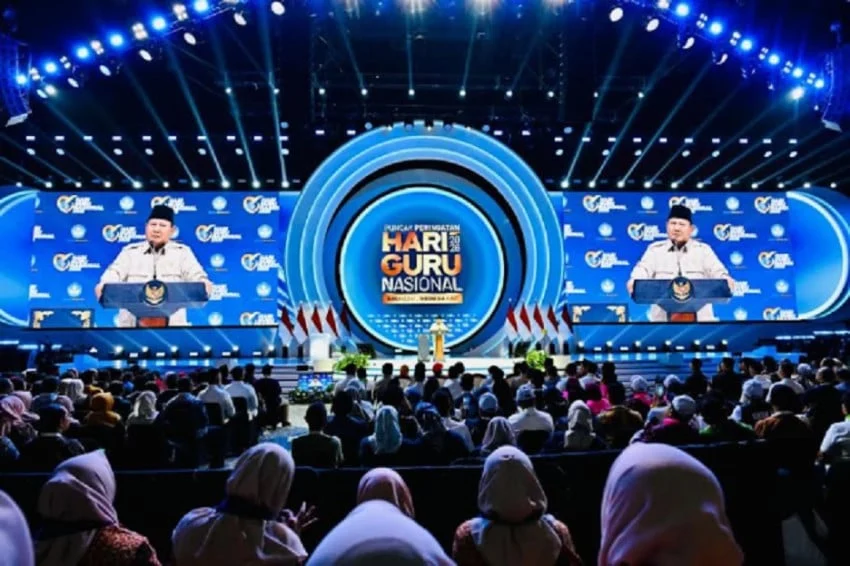
BOGOR — President Prabowo Subianto publicly highlighted a striking
administrative phenomenon characterized by the sudden disappearance of coordinated digital influencers, commonly known as buzzers, alongside a measurable reduction in food poisoning incidents linked to the national Free Nutritious Meal (Makan Bergizi Gratis or MBG) program. The President noted that these significant shifts occurred immediately following a strategic transition in the leadership of the Indonesian National Police (Polri).
The remarks were delivered during a keynote address at the grand commemoration of the 2026 National Teachers Day (Hari Guru Nasional), held at the Sentul International Convention Center (SICC) in Bogor Regency, West Java, on Thursday, November 26, 2026. The high-profile event gathered thousands of educators, government officials, and stakeholders from across the archipelago to discuss the future of education, national discipline, and bureaucratic reform.
Anti-Corruption Agenda and the Call for Educator Support
During his address, President Prabowo dedicated a significant portion of his speech to rallying national support for his administration’s aggressive anti-corruption campaign. He emphasized that safeguarding state finances and recovering assets siphoned off by corrupt actors remain central priorities for his government’s long-term economic strategy.
Addressing the audience of educators directly, Prabowo underscored the critical role that teachers play not only in academic instruction but in shaping the moral foundation of future generations. He urged teachers to serve as moral compasses and active partners in fostering a culture of integrity, transparency, and accountability.
"Therefore, help me finish off those corruptors! We want to save the money, the people’s money," Prabowo stated emphatically to an audience of thousands of teachers.
The President contextualized the ongoing anti-corruption drive as an existential battle for national resources, asserting that funds recovered from illicit channels would be redirected toward public welfare initiatives, educational infrastructure enhancement, and nutrition programs designed to support child development.
The Digital Landscape: Unmasking Coordinated Social Media Attacks
Transitioning to the resistance faced by his administration, President Prabowo candidly discussed the pushback originating from vested interests aiming to disrupt government policies. He pointed to an organized wave of hostile commentary and systemic criticism dominating social media platforms, characterizing the onslaught as a deliberate campaign orchestrated by paid actors rather than genuine public sentiment.
"That is why we are being cursed at on social media. It turns out the social media accounts are all buzzers," Prabowo remarked, drawing murmurs and applause from the auditorium.
The phenomenon of digital manipulation through paid networks has been a growing concern among political analysts and cybersecurity experts in Southeast Asia’s largest economy. These networks often employ automated accounts (bots) and human-operated profiles to amplify manufactured narratives, distort public discourse, and undermine institutional credibility whenever policy reforms threaten entrenched economic privileges.
The Leadership Shift at Polri and Operational Correlations
In a remarkable sequence of observations, President Prabowo linked the sudden tapering of these coordinated digital assaults—as well as a noticeable drop in logistical and distribution anomalies within the Free Nutritious Meal (MBG) program—to the recent structural and personnel changes at the leadership level of the Indonesian National Police.
The MBG program, a flagship social welfare initiative designed to provide daily nutritious meals to millions of school children and pregnant women nationwide, has faced various logistical hurdles, distribution bottlenecks, and isolated safety incidents since its nationwide rollout. Among these challenges, reports of food poisoning in specific regional distributions previously sparked intense public scrutiny and media debate.
According to the President’s observations, the concurrent stabilization of the MBG supply chain—marked by a decrease in contamination and poisoning cases—and the calming of hostile digital campaigns coincided directly with executive interventions and leadership rotations within Polri. While the President did not explicitly detail the mechanical correlation between police leadership restructuring and the reduction of digital disinformation campaigns or supply chain sabotage, the commentary suggested that enhanced internal security oversight, stricter law enforcement against illicit supply syndicates, and improved coordination between state apparatuses played a stabilizing role.
During the same overarching period of institutional renewal, Prabowo has consistently called for a renaissance within the national police force, frequently invoking the legendary integrity and public service ethos of historical police figures such as former National Police Chiefs Jenderal Hoegeng Imam Santoso and Raden Said Soekanto Tjokrodiatmodjo, urging modern personnel to emulate their unwavering dedication to law enforcement and public trust.
Broader Implications for Governance and Public Administration
Political observers and public policy analysts have begun dissecting the implications of President Prabowo’s revelations regarding the nexus between state security, bureaucratic compliance, and information integrity.
The intersection of law enforcement restructuring and the containment of coordinated disinformation campaigns highlights the vulnerability of national development programs to organized interference. Public policy experts note that major structural reforms—particularly those involving massive budget allocations like the MBG program and high-stakes asset recovery initiatives—frequently trigger friction within the political economy, manifesting as both physical logistical disruptions on the ground and psychological warfare in the digital sphere.
The abrupt cessation of hostile social media campaigns following administrative interventions suggests that public narratives are occasionally engineered by specific interest groups seeking to derail reform agendas. By bringing this dynamic into the public consciousness, the administration appears intent on inoculation: preparing the public to critically evaluate digital information while maintaining steady pressure on corrupt networks and operational bottlenecks.
Furthermore, the stabilization of the MBG program remains critical for the administration’s political capital and social welfare objectives. Ensuring food safety, quality control, and transparent supply chain logistics requires multi-agency cooperation, involving the National Nutrition Agency (BGN), regional governments, health authorities, and law enforcement agencies tasked with investigating potential sabotage or substandard procurement practices.
Conclusion and Outlook
As President Prabowo’s administration approaches its upcoming legislative and developmental milestones, the emphasis on institutional integrity, executive discipline, and public communication remains paramount. The revelations at the 2026 National Teachers Day commemoration in Sentul serve as a window into the complex administrative friction defining contemporary Indonesian governance.
With educators enlisted as moral allies in the fight against corruption, and with reinforced security oversight stabilizing vital social programs like the Free Nutritious Meal initiative, the government aims to project resilience against both physical logistical challenges and digital manipulation. Moving forward, the administration’s ability to sustain these positive trajectories will depend heavily on continued inter-agency synergy, stringent oversight of public expenditures, and transparent engagement with the Indonesian public.
