
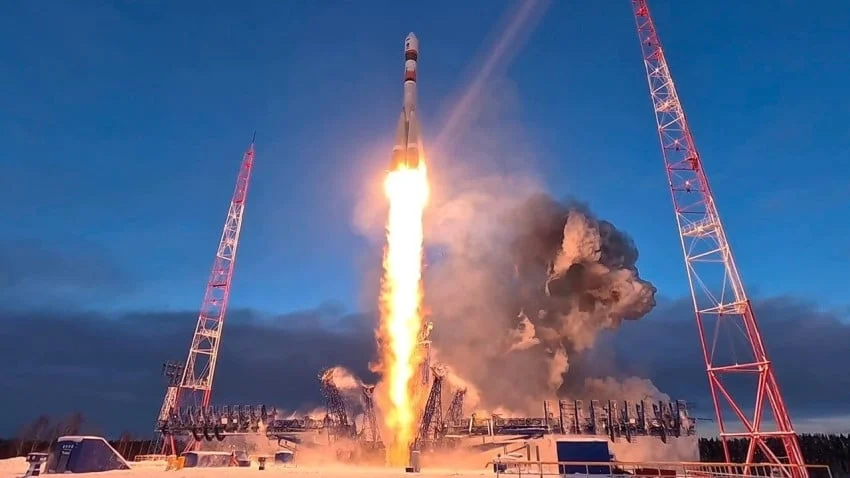
MOSCOW — In a significant escalation of its space-based defense capabilities, the Russian Federation has successfully executed the launch of a specialized military spacecraft into Earth orbit. Liftoff was achieved utilizing a Soyuz-2.1b carrier rocket launched from the Plesetsk Cosmodrome, situated in the northern Arkhangelsk region.
The operation, overseen and confirmed by the Russian Ministry of Defense, underscores Moscow’s ongoing commitment to expanding its orbital infrastructure for strategic defense applications. While the exact classification and primary payload specifics of the spacecraft remain tightly guarded, military analysts and defense circles have categorized the deployment as part of Russia’s broader initiative to establish and maintain a robust military space architecture.
Main Facts of the Launch and Orbital Insertion
According to official statements released by the Russian Ministry of Defense, the launch sequence proceeded precisely according to parameters. The Soyuz-2.1b booster lifted off from the state test cosmodrome in Plesetsk without incident.
Following the initial ascent, telemetry data confirmed the successful separation of the rocket stages and the precise injection of the payload into its designated target orbit. Once orbital insertion was verified, telemetry and operational control of the spacecraft were promptly transferred to the ground-based automated control systems managed by the Russian Aerospace Forces (VKS).
Preliminary diagnostics conducted by military engineers indicate that all onboard systems and subsystems are functioning normally, operating within established parameters. The successful placement of this asset highlights the continued reliability of the Soyuz-2.1b medium-lift launch vehicle, which has long served as a workhorse for both civilian and military payloads within the Russian federal space program.
Chronology of Events and the "Space Jellyfish" Phenomenon
The trajectory of the Soyuz-2.1b rocket took it over several northern Russian territories, creating a striking and unexpected visual spectacle for residents on the ground. Shortly after liftoff, observers across parts of the neighboring Komi Republic reported a luminous, expanding gaseous formation in the night sky.
Eyewitnesses quickly captured photographs and video footage of the glowing phenomenon, which rapidly spread across social media platforms. The glowing display resembled a vast, translucent jellyfish or an expanding cosmic nebula, prompting widespread curiosity and temporary alarm among local residents.
Astronomical and aerospace experts quickly identified the spectacle as a classic high-altitude rocket plume phenomenon, colloquially referred to by observers as a "space jellyfish." This striking visual effect occurs under specific atmospheric and lighting conditions during a launch. Typically, it is produced when the first stage of a rocket exhausts its propellant and separates, or when the second-stage engine ignites at high altitudes. At heights exceeding several dozen kilometers, the expanding exhaust gases are brightly illuminated by the rising or setting sun, while observers on the ground are positioned in darkness. The high-altitude sunlight reflects off the microscopic fuel exhaust particles and unburned propellant gases, causing them to expand and glow against the backdrop of the night sky.
Background Context: The Strategic Importance of Plesetsk Cosmodrome
The choice of the Plesetsk Cosmodrome for this strategic launch is far from coincidental. Located approximately 800 kilometers north of Moscow, Plesetsk has historically served as Russia’s premier launch facility for military, reconnaissance, and navigation satellites.
Unlike the Baikonur Cosmodrome, which Russia leases from Kazakhstan and primarily utilizes for crewed missions and heavy geostationary payloads, Plesetsk is situated entirely on sovereign Russian territory. Its high northern latitude makes it exceptionally well-suited for launching spacecraft into polar and high-inclination orbits. These orbital planes are critical for global surveillance, early-warning missile tracking, meteorological monitoring, and secure military communications.
In recent years, the Russian Ministry of Defense has heavily invested in modernizing the infrastructure at Plesetsk. These upgrades are designed to accommodate a new generation of launch vehicles, including the Soyuz-2 series and the Angara family of rockets, ensuring that the nation retains independent and reliable access to space for both strategic defense and national security requirements.
Official Responses and Institutional Context
The Russian military establishment has maintained a measured yet triumphant tone regarding the successful deployment. Ministry officials emphasized the seamless coordination between launch crews, rocket manufacturers, and the Aerospace Forces.
The Space Forces component of the Russian military, which assumed control of the asset immediately following orbit insertion, plays an increasingly vital role in modern Russian military doctrine. Tasked with monitoring space objects, providing early warning against ballistic missile attacks, and managing the nation’s military satellite constellations, the Space Forces have seen their operational responsibilities expand significantly over the past decade.
While foreign defense intelligence agencies closely monitor such launches for potential dual-use or offensive space capabilities, Moscow has consistently maintained that its space activities comply with international law and are strictly designed to safeguard national security and maintain strategic parity.
Broader Impact, Analysis, and Implications
The successful deployment of this military space platform carries several important implications for global geopolitics and the evolving domain of astropolitics. As space becomes increasingly congested and militarized, major global powers—including the United States, China, and Russia—are accelerating the deployment of advanced orbital assets.
-
Enhanced Situational Awareness and Command: Platforms placed into low and medium Earth orbits provide vital capabilities for real-time battlefield intelligence, tactical communications, and navigation redundancy. For the Russian military, enhancing these orbital capabilities helps mitigate traditional geographic disadvantages and provides a force multiplier for conventional and strategic forces alike.
-
The Militarization of Low Earth Orbit (LEO): Incidents of this nature underscore the ongoing transformation of space from a purely scientific and commercial frontier into an contested operational domain. Military analysts point out that as nations develop more sophisticated orbital architectures, the lines between defensive surveillance and offensive counter-space capabilities continue to blur.
-
Technological Resilience: The reliance on the Soyuz-2.1b launch vehicle demonstrates continuity in Russia’s aerospace manufacturing capabilities despite years of international economic sanctions. Maintaining an autonomous supply chain for rocket production and electronic components remains a top priority for Moscow’s defense-industrial complex.
As the newly deployed space asset continues its operational commissioning phase, ground control stations will conduct rigorous testing of its payload systems. Meanwhile, the visual legacy of its ascent—the memorable "space jellyfish" over the Komi Republic—serves as a tangible reminder to the public of the heavy activity taking place quietly above the Earth’s atmosphere, where the strategic competition of major powers is increasingly being played out.
