
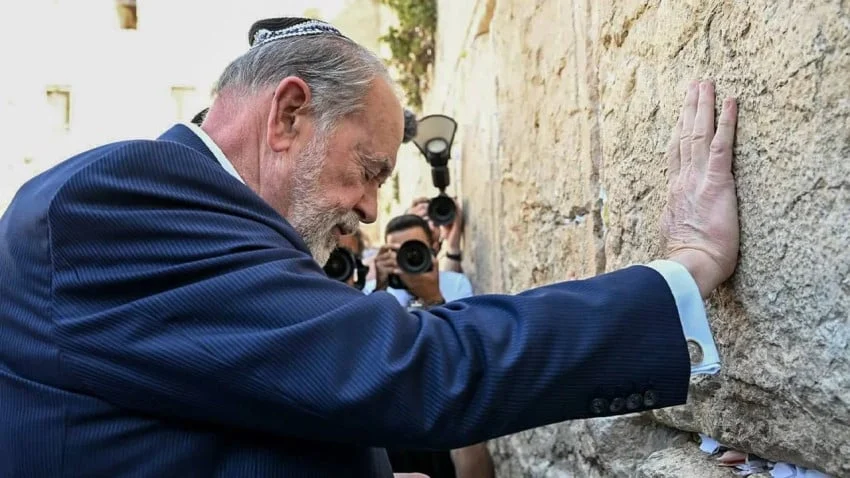
WASHINGTON — A controversy has erupted across the United States political landscape following the circulation of a podcast clip featuring Mike Huckabee, the United States Ambassador to Israel. In the recording, Ambassador Huckabee asserted that individuals opposing a United States-Israel military conflict against Iran are suffering from “spiritual darkness” and are being manipulated by Satan. The remarks, originally made during an appearance on The Anchor Podcast hosted by Israeli commentator Amir Tsarfati on October 23, have ignited a fierce debate regarding the boundaries of diplomatic rhetoric, the influence of religious ideology on foreign policy, and the growing internal fractures within the American conservative movement.
The video clip resurfaced on social media platforms late last week, rapidly gaining traction and triggering widespread public condemnation. The backlash arrives at a politically sensitive juncture in Washington, unfolding in the wake of United States midterm elections that analysts widely interpret as a referendum on the foreign policy agenda of the Trump administration, specifically concerning escalating military engagements in the Middle East. As critics from both sides of the political spectrum voice alarm, the controversy has reignited discussions on the separation of church and state in diplomatic discourse and the potential implications of framing geopolitical conflicts in apocalyptic or theological terms.
The Podcast Appearance and Controversial Remarks
During his October 23 interview on The Anchor Podcast, Ambassador Huckabee engaged in a wide-ranging discussion concerning Middle Eastern geopolitics, the strategic posture of the United States, and the existential threats facing Israel. The conversation eventually turned toward domestic and international opposition to military action against Iran.
Expanding upon his worldview, Huckabee stated that “Satan has blinded the minds” of those who criticize a military campaign against Iran and has managed to “control their thinking.” He went further, characterizing the dissenters as individuals experiencing “spiritual darkness, spiritual blindness.”
Recognizing the unconventional nature of his remarks for a seated diplomat, Huckabee briefly paused during the interview to acknowledge the gravity of his phrasing. “I know it sounds a little weird for an ambassador to talk like this,” he remarked before continuing to articulate his theological framework regarding geopolitical opposition.
While such rhetorical flourishes were a hallmark of Huckabee’s decades-long career as an evangelical pastor and conservative television commentator, their deployment by a credentialed diplomat representing the United States government has transformed a theological opinion into a high-stakes diplomatic liability.
Chronology of Events
To understand the trajectory of the current political firestorm, it is necessary to examine the timeline of events leading up to the public outcry:
- October 23: Ambassador Mike Huckabee records an appearance on The Anchor Podcast, hosted by Amir Tsarfati. During the interview, he attributes opposition to a US-Israel war against Iran to demonic influence and spiritual blindness.
- Late October to Early November: The full-length podcast episode circulates primarily among niche political and religious circles without attracting mainstream governmental or media attention.
- Mid-Term Election Period: The United States conducts midterm elections, with foreign policy and military entanglements in the Middle East serving as central themes in voter deliberations and debates over executive overreach.
- Late Last Week: A targeted excerpt of the podcast featuring Huckabee’s controversial remarks is isolated and uploaded to mainstream social media platforms. The clip goes viral, attracting millions of views and drawing sharp criticism from political commentators, progressive activists, and traditional conservatives alike.
- Present: Calls for administrative action, formal retractions, and the potential recall of Ambassador Huckabee mount as editorial boards and political analysts dissect the implications of his statements.
Domestic and Conservative Backlash
Perhaps the most notable dimension of the backlash against Ambassador Huckabee is the source of some of the sharpest critiques: members of the American conservative movement. Historically, Huckabee has enjoyed widespread support among evangelical Christians and mainstream conservatives, bolstered by his tenure as Governor of Arkansas and his two presidential bids. However, his recent diplomatic declarations have exposed deep ideological fault lines within the conservative coalition, particularly between hawkish internationalists and a rising faction of anti-interventionist conservatives.
Andrew Day, senior editor at The American Conservative, publicly rebuked the ambassador’s comments in a scathing critique published shortly after the clip went viral.
“‘I know it sounds a little weird for an ambassador to talk like this,’ ujar Duta Besar Huckabee, seraya melontarkan teori bahwa orang-orang yang menentang perang dengan Iran dikendalikan oleh Setan,” wrote Day. “Yes, it is weird!”
Day’s sentiments were echoed by numerous other conservative intellectuals and writers who expressed profound discomfort with a senior diplomat reducing complex geopolitical disagreements to a cosmic battle between good and evil. Critics argued that framing policy debates in theological absolutes leaves no room for diplomatic compromise, prudential statecraft, or legitimate democratic dissent. Furthermore, commentators noted that such rhetoric undermines the foundational American principle of a secular government, where foreign policy decisions are ostensibly weighed on the scales of national security, strategic interest, and international law rather than sectarian spiritual beliefs.
In addition to harsh media commentary, political pressure has rapidly escalated. A growing coalition of civil liberties groups, good-governance organizations, and progressive lawmakers have begun formally petitioning the White House and the Department of State, demanding that Ambassador Huckabee be formally censured or outright removed from his post in Tel Aviv.
Broader Policy Implications and Geopolitical Context
The timing of Huckabee’s remarks could hardly be more delicate. The United States and Israel maintain a deeply intertwined strategic alliance, but tensions regarding the precise trajectory of regional policy—particularly concerning Iran’s nuclear program and proxy networks—have remained a subject of intense debate among military planners, intelligence analysts, and diplomats.
A war with Iran represents one of the most perilous scenarios in modern international relations, carrying immense risks that extend far beyond the immediate theatre of conflict. Potential consequences include catastrophic disruptions to global energy markets, severe economic fallout, the activation of extensive regional proxy networks targeting Western assets, and the mobilization of major global powers holding vested interests in regional stability.
Given these high stakes, foreign policy experts emphasize that public debate regarding military intervention requires rigorous, objective analysis grounded in strategic realities, intelligence assessments, and diplomatic calculus. When high-ranking representatives of the United States government dismiss legitimate strategic concerns, constitutional questions, or anti-war sentiment as the product of "spiritual blindness" or demonic possession, it fundamentally degrades the quality of public discourse and impairs effective democratic oversight.
Moreover, the appointment of ambassadors carries the implicit expectation that such individuals will act as sober, steady representatives of a diverse populace possessing a wide spectrum of beliefs. When a diplomat utilizes their official platform to delegitimize domestic political opponents through religious disparagement, it risks alienating allies, inflaming domestic polarization, and complicating diplomatic engagements in a volatile region where religious sensitivities are already exceptionally high.
Official Silence and Continuing Fallout
As of press time, neither the Department of State nor the White House has issued a formal statement addressing Ambassador Huckabee’s podcast remarks. Officials have declined repeated requests for comment regarding whether the ambassador’s statements violate internal codes of conduct for diplomatic personnel or whether formal guidance has been issued reminding Senate-confirmed envoys of the sensitivities surrounding public media appearances.
Political analysts suggest that the administration may attempt to weather the storm by maintaining a policy of calculated silence, hoping that the 24-hour news cycle will dilute the outrage. However, given the intensity of the pushback from both the political left and the conservative non-interventionist right, the controversy threatens to linger as a persistent distraction for United States foreign policy in the Middle East.
As the debate continues to unfold across digital platforms and editorial pages, the incident serves as a stark reminder of the challenges inherent in modern political communication, where off-the-cuff remarks made on alternative media channels can rapidly transform into international diplomatic crises. Whether Ambassador Huckabee will issue a clarification, apologize, or face formal administrative consequences remains to be seen, but the fallout has irrevocably altered the discourse surrounding his tenure as the senior representative of the United States in Israel.
