
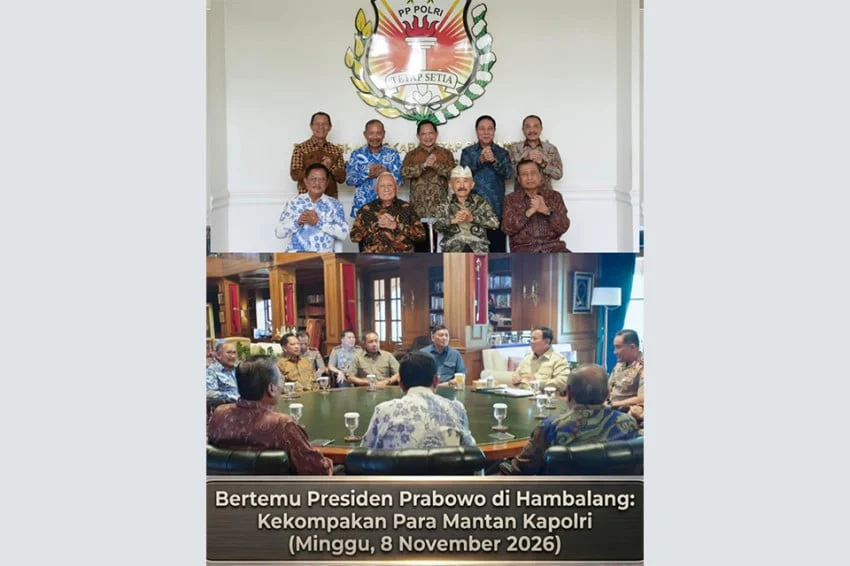
BOGOR — In a significant display of national solidarity and institutional continuity, President Prabowo Subianto welcomed a high-profile delegation of ten former Chiefs of the Indonesian National Police (Kapolri) spanning multiple generations. The closed-door gathering took place on Sunday, November 8, 2026, at the personal residence of the Head of State located in Hambalang, Bogor Regency, West Java.
The meeting brought together a formidable assembly of leadership experience from Indonesia’s internal security apparatus. The delegation included current Minister of Home Affairs, retired General Tito Karnavian, alongside nine other former top cops who have shaped the trajectory of the National Police—officially known as Kepolisian Negara Republik Indonesia (Polri)—over the past several decades.
This high-level consultation underscored the administration’s ongoing efforts to maintain open channels of communication with seasoned national figures, leveraging decades of collective institutional wisdom to address contemporary governance and security challenges.
A Historic Cross-Generational Assembly
The delegation represented a comprehensive cross-section of modern Indonesian policing history, reflecting leadership eras stretching from the late 1990s through the 2020s. Among those present alongside Minister Tito Karnavian were retired generals Roesmanhadi, Rusdihardjo, Surojo Bimantoro, Da’i Bachtiar, Sutanto, Bambang Hendarso Danuri, Timur Pradopo, Sutarman, and Badrodin Haiti.
The presence of such a large quorum of former police chiefs highlights a unique tradition of advisory camaraderie within Indonesia’s security elite. Despite having concluded their active tenures at the helm of the 400,000-plus strong police force, these leaders continue to exert influence as elder statesmen within the nation’s strategic security and political architecture.
Arriving at the Hambalang hilltop estate, the former chiefs—dressed uniformly in traditional batik shirts—were greeted personally by President Prabowo Subianto. The atmosphere was marked by warmth and mutual respect as the President walked down the receiving line, exchanging pleasantries and shaking hands with each official individually.
In a moment captured by media observers, President Prabowo warmly approached retired General Roesmanhadi, asking, "How are you doing, Mas (Roesmanhadi)?" To which the former police chief cheerfully replied, "Doing very well." This informal yet respectful interaction set the tone for a meeting that balanced political gravity with personal camaraderie.
Context and Background of the Hambalang Summit
The gathering at Hambalang occurs against a backdrop of complex domestic security landscapes and administrative transitions. Since taking office, President Prabowo has frequently engaged with former military and police commanders, institutional veterans, and civil society leaders to build a broad coalition of national support for his administration’s core policy objectives.

Hambalang, long known as a symbolic political retreat and strategic meeting place for Prabowo, has increasingly served as a venue for high-level state consultations. Sunday’s meeting fits into a broader pattern of executive outreach designed to tap into the institutional memory of Indonesia’s security veterans.
The inclusion of Minister of Home Affairs Tito Karnavian in the delegation bridges two critical pillars of state governance: domestic security and regional administration. As a former Kapolri who transitioned successfully into cabinet-level politics, Tito’s presence emphasized the fluid interplay between law enforcement leadership and national governance.
Furthermore, assembling ten former police chiefs provides the current administration with a direct sounding board regarding regional stability, law enforcement reform, and community policing strategies. While official readouts of the closed-door discussions remained broad, sources close to the administration suggest that topics ranged from national resilience and crime prevention to maintaining public order amidst shifting geopolitical and economic pressures.
Chronology of Leadership: The Evolution of Polri
To understand the weight of the delegation present in Hambalang, one must examine the chronological span of their respective tenures, each representing a distinct chapter in Indonesia’s post-Soeharto reform era:
- General Pol. (Ret.) Roesmanhadi (1998–2000): Guided the national police force through the turbulent transition of the Reformasi era, navigating the early stages of police separation from the Indonesian Armed Forces (ABRI).
- General Pol. (Ret.) Rusdihardjo (2000): Briefly led the institution during a period of rapid administrative decentralization and constitutional restructuring.
- General Pol. (Ret.) Surojo Bimantoro (2000–2001): Managed institutional stabilization amid intense political friction between the executive and legislative branches at the national level.
- General Pol. (Ret.) Da’i Bachtiar (2001–2005): Oversaw the creation of the elite counter-terrorism unit, Densus 88, in the immediate aftermath of the 2002 Bali bombings, transforming Indonesia’s approach to international terrorism.
- General Pol. (Ret.) Sutanto (2005–2008): Renowned for rigorous internal anti-corruption campaigns and structural transparency initiatives within the police force.
- General Pol. (Ret.) Bambang Hendarso Danuri (2008–2010): Focused heavily on modernizing investigative techniques and expanding regional infrastructure for law enforcement.
- General Pol. (Ret.) Timur Pradopo (2010–2013): Navigated high-profile political corruption investigations and public accountability demands during a booming digital media era.
- General Pol. (Ret.) Sutarman (2013–2015): Championed community-oriented policing models and institutional restraint during fiercely contested national elections.
- General Pol. (Ret.) Badrodin Haiti (2015–2016): Stabilized the force through sudden leadership transitions and managed major security operations surrounding radicalization threats.
- General Pol. (Ret.) Muhammad Tito Karnavian (2016–2019): Spearheaded technological modernization within policing, managed massive public security mobilizations, and later transitioned into executive governance as Home Minister.
Implications and Strategic Analysis
Political analysts and governance experts view the Hambalang meeting as a masterclass in coalition maintenance and institutional diplomacy. By bringing together leaders who managed the police force through some of Indonesia’s most volatile historical milestones, President Prabowo has reinforced a united front among the country’s security elite.
From a policy perspective, engaging former Kapolris provides the executive branch with invaluable institutional insight. Policing in the archipelago nation of over 270 million people presents unique logistical, cultural, and political challenges. The collective tenure of the ten visiting generals encompasses decades of crisis management—ranging from communal conflicts and separatist movements to modern cybercrime and transnational drug trafficking.
Moreover, the optics of the meeting send a strong signal regarding internal stability. In emerging democracies, ensuring the alignment and tacit support of retired security sector heavyweights is crucial for maintaining civil-military-police harmony. The visual of ten former chiefs standing shoulder-to-shoulder with the sitting president—and their former colleague, the Minister of Home Affairs—projects a unified institutional image to both domestic and international observers.
Conclusion
As President Prabowo Subianto continues to steer his legislative and developmental agenda, consultations with seasoned national figures like the ten former Kapolris serve as a bridge between historical legacy and future policy execution. The Sunday gathering in Hambalang was not merely a ceremonial reunion, but a strategic alignment of Indonesia’s security establishment, reinforcing the foundational pillars of law, order, and national unity for the years ahead.
