
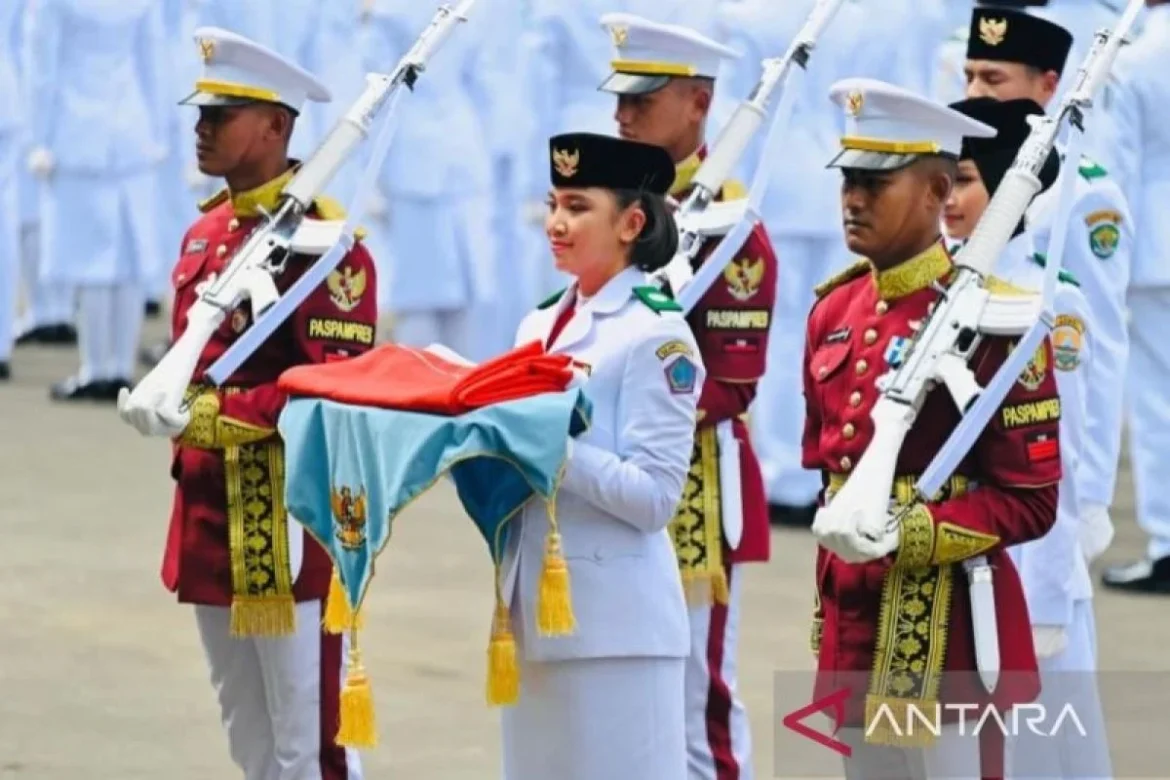
Jakarta – As the Indonesian nation prepares to commemorate its Independence Day, the meticulous choreography and disciplined alignment of the national flag-hoisting troop—widely known as Pasukan Pengibar Bendera Pusaka, or Paskibraka—remains one of the most anticipated and revered spectacles of the national ceremony. Beyond the precision marching and the crisp sound of leather boots hitting the asphalt, every element of the parade formation carries profound historical weight. At the heart of this visual grandeur is the legendary 17-8-45 formation, a structural arrangement that is far more than a mere tactical display of drill proficiency; it is a living monument to the birth of the Republic of Indonesia.
The 17-8-45 nomenclature directly encapsulates the sacred date of the Indonesian Proclamation of Independence: August 17, 1945. When deployed during state ceremonies, the formation transforms the ceremonial ground into a historical canvas, reminding millions of citizens and state dignitaries of the tumultuous and courageous struggle that birthed a sovereign nation from the ashes of colonial rule. Understanding the architecture of this formation requires a deep dive into its tripartite division, its historical origins, and its enduring evolution within the contemporary sociopolitical landscape of modern Indonesia.
Anatomy of a Historic Formation: Breaking Down 17-8-45
The traditional Paskibraka formation deployed during Independence Day celebrations is systematically divided into three distinct operational groups. Each unit is assigned specific duties, positioning, and symbolic numeric values that correspond directly to the timeline of Indonesia’s independence.
Leading the charge at the very front of the procession is Pasukan 17. Comprising 17 personnel, this vanguard unit acts as the pathfinder, escort, and guide for the entire contingent. Numerically, the figure 17 honors the exact calendar date—the seventeenth day—of August 1945, marking the moment when the founding fathers formally declared the nation’s independence to the world.
Immediately following the vanguard is the nucleus of the entire ceremony: Pasukan 8. Consisting of 8 members, this elite core group holds the gravest responsibility of the day—handling the actual retrieval, carrying, and hoisting of the sacred heirloom flag, the Sang Saka Merah Putih (or its official replica). The number 8 signifies the eighth month of the year, August, sealing the month of liberation into the physical movement of the troop.
Positioned securely behind the core group is Pasukan 45, the largest unit in the formation. Comprising 45 personnel, this group serves as the ceremonial guard of honor, providing security, structural balance, and an aura of formidable defense. The number 45 immortalizes the year 1945, the monumental year that marked the end of foreign occupation and the establishment of an independent republic.
When unified on the field, these three components—17, 8, and 45—forge a seamless narrative of the nation’s genesis. This arithmetic precision ensures that the history of the proclamation is not merely read in textbooks, but physically enacted and witnessed by the public.
The Genesis of a Tradition: The Husein Mutahar Connection
The creation of this iconic formation did not happen by accident; it is the brainchild of one of Indonesia’s most dedicated nationalist figures, Husein Mutahar. Born in Semarang in 1916, Mutahar was a prominent composer of patriotic songs, a diplomat, and a stalwart nationalist who dedicated much of his life to youth development and state symbolism.
The conceptual timeline of Paskibraka traces back to the turbulent era immediately following World War II. In 1946, as the capital of the young republic was temporarily shifted to Yogyakarta due to allied and Dutch military aggression, President Sukarno personally entrusted Husein Mutahar with the solemn duty of organizing the independence day flag-hoisting ceremony at the Gedung Agung presidential palace.
Mindful of the precarious security situation and the symbolic gravity of the moment, Mutahar opted for a minimalist yet highly symbolic approach. He selected five extraordinary youths—representing different regional backgrounds—to raise the sacred flag. This initial grouping of five symbolized the five pillars of the newly formulated state ideology, Pancasila.
Two decades later, in 1967, as the nation entered a new political chapter under President Suharto, the administration sought to formalize and grandly scale up the national flag-hoisting ceremony. President Suharto summoned Husein Mutahar once again, tasking him with designing a permanent, standardized framework for the national youth troop. Drawing inspiration from his modest 1946 arrangement, Mutahar expanded the concept into a more comprehensive, multi-tiered formation.
Thus, the 17-8-45 configuration was formally institutionalized. Mutahar’s vision was to instill a profound sense of historical consciousness directly into the minds of the participating teenagers, ensuring that the physical labor of marching and drilling was constantly anchored to the blood, sweat, and sacrifices of the 1945 generation.
Operational Demands and Rigorous Coordination
Executing the 17-8-45 formation is an immense test of human endurance, mental fortitude, and absolute synchronization. The 70-plus teenagers selected from across Indonesia’s provinces undergo months of grueling isolation and physical conditioning during training camps. They must master complex marching maneuvers, maintain flawless posture under the tropical sun, and execute split-second timing.
Each of the three sub-units faces unique operational pressures during the live broadcast of the state ceremony:
Pasukan 17 must maintain impeccable pacing and geometry, ensuring that the vanguard sets a steady, dignified tempo for the entire column. Any slight miscalculation in stride can disrupt the rhythm of the entire troop.
Pasukan 8 carries the psychological weight of the nation. The flag bearers must navigate the steps of the grand stage with absolute grace and precision. The handover of the flag from the state official to the main bearer requires a level of focus where zero error is tolerated.
Pasukan 45, acting as the guard of honor, must project unwavering strength and vigilance. Armed with ceremonial rifles, their movements must be sharp, synchronized, and thunderously unified to command the respect of the audience and foreign dignitaries alike.
This intricate division of labor demands a high degree of multidisciplinary coordination. Coaches, military instructors, and medical teams work round-the-clock during the centralized training camps—such as those held at national and regional levels ahead of the August celebrations—to ensure that every cadet can perform flawlessly under high-stress conditions.
Symbolism, Adaptability, and Modern Implications
While the 17-8-45 formation remains the golden standard for Independence Day commemorations, the structure of Paskibraka is not entirely rigid and has shown a capacity for meaningful adaptation. State institutions recognize that while the core values of nationalism remain constant, ceremonial layouts can occasionally be tailored to honor other foundational milestones of the republic.
For instance, during specific state events such as the Pancasila Sanctity Day or specialized national holidays, supervisory bodies like the Pancasila Ideology Development Agency (BPIP) have authorized alternative configurations. A notable example includes formations structured into five distinct groups to mirror the five principles of Pancasila, emphasizing holistic state philosophy alongside historical timelines.
Nevertheless, the enduring appeal of the 17-8-45 formation lies in its ability to transcend generations. In an era of rapid modernization, digital distraction, and globalized cultural influences, the visual spectacle of Paskibraka serves as a powerful anchor for national identity. For the youth selected into the ranks—ranging from urban high-achievers to pioneering students from remote regions like the Seribu Islands or rural schools—becoming a member of Paskibraka is a transformative rite of passage.
Sociologists and cultural analysts note that rituals like the Paskibraka deployment play an indispensable role in state-building. By physically embodying the date August 17, 1945, the young participants internalize the narrative of self-determination. They cease to be mere students marching on a field; they become living custodians of historical memory.
As preparations ramp up for upcoming national anniversaries, from training camps in the provincial capitals to final rehearsals at the presidential palaces, the timeless footprint of Husein Mutahar’s design continues to guide the nation’s youth. The 17-8-45 formation stands as a testament to the fact that history is not merely written in documents, but is marched forward, step by disciplined step, by the future generations of the republic.
