
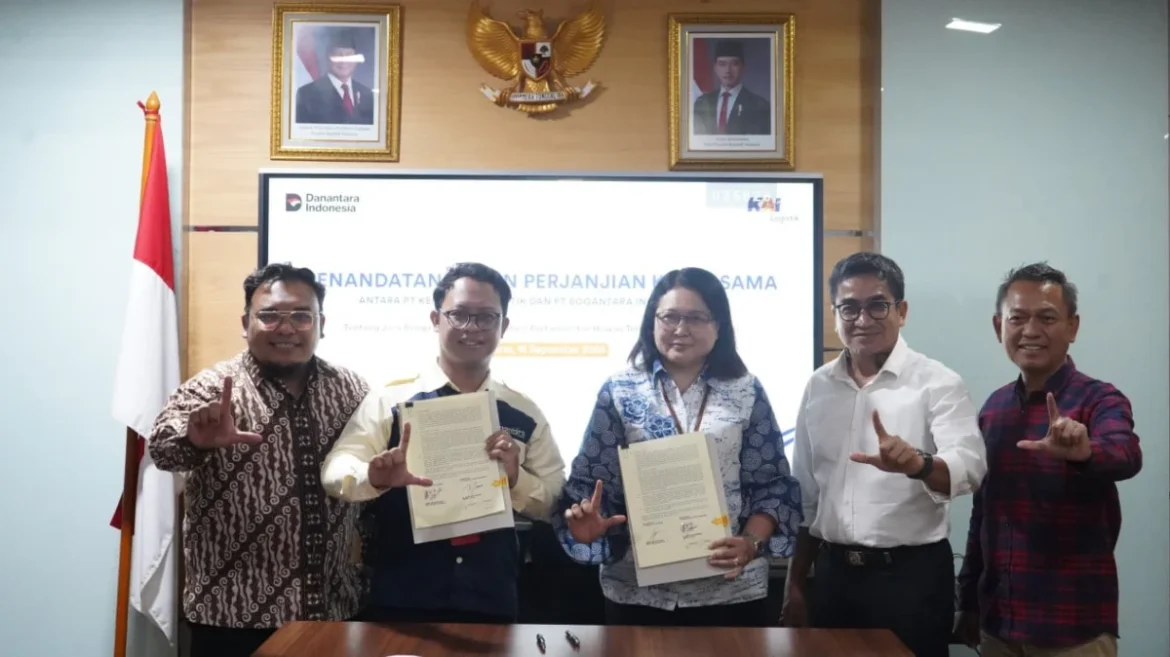
Jakarta – In a major development poised to transform the landscape of national supply chain logistics, PT KAI Logistik (KAI Logistics), a subsidiary of state-owned railway operator PT Kereta Api Indonesia (Persero), has officially entered into a comprehensive strategic partnership with PT Bogantara Indo Transport. The landmark agreement establishes a framework for the large-scale distribution and transportation of agricultural products, food commodities, livestock, and related goods utilizing the railway network.
The formal signing ceremony marks a critical milestone in Indonesia’s multimodal transportation sector. By integrating rail freight deeper into the agricultural supply chain, the collaboration aims to bridge the logistical gap between major production hubs and primary consumption centers. The initiative is designed to address longstanding inefficiencies in domestic food distribution, reduce carbon emissions associated with heavy road freight, and guarantee the freshness and quality of perishable goods traveling long distances across the archipelago.
A Strategic Vision for National Food Security and Distribution
Speaking at the signing ceremony, Yuskal Setiawan, President Director of KAI Logistics, emphasized that the collaboration extends far beyond conventional commercial logistics. According to Setiawan, the partnership represents a synergistic approach to solving complex distribution challenges, ultimately delivering broader socioeconomic benefits to the Indonesian public.
"We view food commodities as a vital strategic component of community life, which necessitates a distribution system that is secure, reliable, scheduled, and capable of seamlessly bridging production centers with consumption hubs in a highly effective manner," Setiawan stated in an official release. He further highlighted that reliable railway logistics play an indispensable role in maintaining the continuity and stability of the national food supply chain.
The agreement was formally executed by Aniek Dwi Deviyanti, Director of Business Development at KAI Logistics, and M. Farid Nor Rohman, President Director of PT Bogantara Indo Transport. Under the terms of the accord, both entities have committed to developing and scaling up specialized freight services connecting Banyuwangi in East Java with the capital city of Jakarta, operating on a round-trip basis.
The ambitious project is scheduled to run for a multi-year term, commencing in November 2026 and extending through December 2030. Projections outlined in the agreement indicate that the partnership will utilize approximately 84,200 flatbed rail cars over the course of the contract, underlining the massive operational scale and long-term commitment of both enterprises.
Pioneering Rail Logistics for Livestock and Perishables
The inclusion of live animals—specifically live cattle—alongside fresh vegetables, fruits, and staple food items represents a groundbreaking technical and operational achievement for Indonesia’s railway freight sector. Aniek Dwi Deviyanti elaborated on the innovative nature of the service, noting that the transportation of live livestock via commercial freight trains is a first-of-its-kind initiative for the company.
"For KAI Logistics, this service represents an entirely new offering and serves as the pioneering development designed specifically to meet the complex logistical needs of transporting these particular commodities using the railway network," Deviyanti explained.
Transporting agricultural produce and live animals simultaneously requires vastly different handling protocols. To ensure absolute compliance with industry standards, the freight operations will deploy specialized, customized containers engineered to match the precise physiological and physical characteristics of each commodity type.
These high-tech containers adhere strictly to rigorous technical benchmarks, safety protocols, operational viability standards, comprehensive testing phases, and official certification requirements. Furthermore, the handling procedures comply fully with prevailing statutory regulations governing animal welfare and food safety. Consequently, the newly developed service places equal emphasis on maximizing transport capacity, ensuring operational safety, maintaining cargo integrity, and upholding humane treatment standards for livestock throughout transit.
Industry Perspective and Operational Integration
Echoing the sentiments of KAI Logistics leadership, M. Farid Nor Rohman, President Director of PT Bogantara Indo Transport, welcomed the alliance as a revolutionary breakthrough in the distribution of agricultural commodities, food supplies, and livestock. He stressed that establishing a dependable, fixed-schedule rail link is vital for regional producers seeking unhindered access to broader consumer markets.
"This collaboration is fundamentally important to ensure that products originating directly from agricultural production regions can be seamlessly connected to the wider market in a more effective and sustainable manner," Nor Rohman remarked. By establishing a predictable supply chain corridor between East Java—a major agricultural and livestock heartland—and Jakarta, the nation’s primary economic engine, producers can mitigate post-harvest losses and inventory fluctuations.
The operational architecture of the Banyuwangi–Jakarta rail corridor has been meticulously designed to accommodate the time-sensitive nature of fresh produce and the logistical complexities of moving live cattle. By shifting significant freight volumes from congested national highways to the dedicated railway grid, the initiative aligns closely with national sustainability goals aimed at reducing highway maintenance burdens, cutting vehicular carbon emissions, and lowering overall logistics costs.
Timeline, Phased Rollout, and Future Projections
The roadmap for the KAI Logistics and PT Bogantara Indo Transport partnership spans a crucial four-year operational window, designed to ensure steady capacity expansion and service refinement:
- September 2026: Formalization of the strategic partnership and execution of the cooperative agreement between KAI Logistics and PT Bogantara Indo Transport.
- September to October 2026: Technical preparation phase, including the fabrication and certification of specialized, commodity-specific containers, route testing, and infrastructure readiness assessments along the Banyuwangi–Jakarta corridor.
- November 2026: Official commercial launch of the specialized rail freight service, initiating initial round-trip shipments of fresh agricultural produce, staple foods, and live cattle.
- 2027 – 2030: Phased scaling of operations, with cumulative targets reaching approximately 84,200 deployed flatbed rail cars over the four-year contract duration.
This structured timeline ensures that both corporations can incrementally scale their infrastructural investments, train specialized personnel, and optimize turnaround times at key terminal stations.
Broader Implications for Indonesia’s Supply Chain Ecosystem
The launch of this pioneering rail-based distribution service arrives at a critical juncture for the Indonesian economy. High logistics costs have historically posed a persistent challenge to national competitiveness, with transportation expenses frequently consuming a disproportionate share of agricultural commodity pricing.
By leveraging the high-capacity, weather-resilient, and fuel-efficient nature of railway transport, the KAI Logistics and PT Bogantara Indo Transport venture offers a viable blueprint for modernizing domestic supply chains. The expected deployment of 84,200 flatbed rail cars over the contract period highlights the tangible capacity of rail freight to absorb heavy industrial and agricultural transport demands that traditionally relied exclusively on long-haul trucking fleets.
Furthermore, the introduction of certified, animal-welfare-compliant livestock transport via train sets a new benchmark for the livestock industry. Ensuring that cattle can be transported efficiently over long distances without the physical stress and mortality risks often associated with multi-day overland truck journeys represents a major welfare and economic victory for the sector.
Ultimately, as the November 2026 launch date approaches, industry observers will closely monitor the operational rollout of this strategic alliance. If successful, the model established between KAI Logistics and PT Bogantara Indo Transport could pave the way for expanded railway distribution networks across other key agricultural corridors throughout Sumatra, Java, and Sulawesi, fundamentally reshaping the future of Indonesia’s food security and multimodal logistics infrastructure.
