
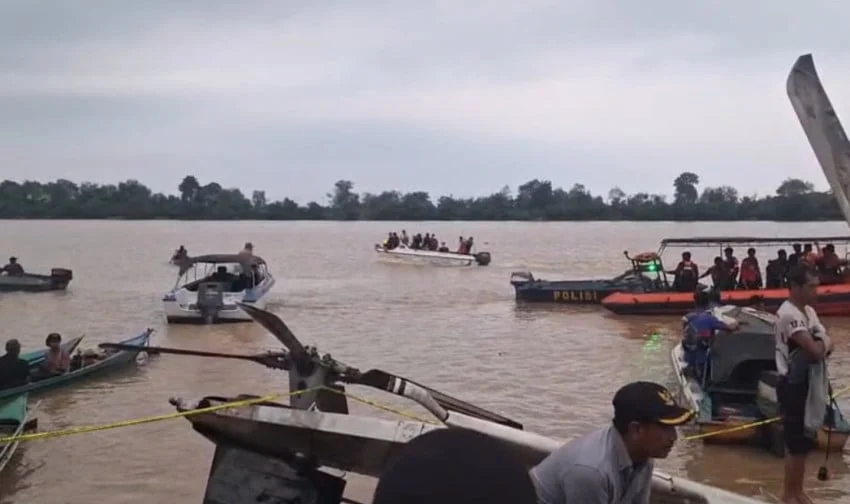
The aviation community and disaster response agencies in Indonesia are in mourning following the tragic discovery of Yayan Supyansuri, a Helicopter Landing Officer (HLO) who lost his life in the crash of a Super Puma H-255 helicopter. The aircraft, bearing registration number VH-HGM, plummeted into the waters of the Barito River near Desa Tabatan, Kuripan District, Barito Kuala Regency, South Kalimantan, on Sunday, November 8, 2026. The incident occurred while the crew was actively engaged in critical aerial firefighting operations to mitigate the spread of forest and land fires (karhutla) that have plagued the region during the current dry season.
The Chronology of the Incident
The distress signal associated with the Super Puma H-255 was reported on the afternoon of Sunday, November 8. According to preliminary reports, the helicopter was performing a sortie as part of a government-sanctioned mission to combat escalating wildfires in South Kalimantan. The Barito River region, characterized by its complex hydrological landscape and dense riparian vegetation, proved a challenging environment for aerial operations.
Witnesses in the vicinity of Desa Tabatan reported observing the aircraft experiencing technical difficulties before its descent into the water. By the time emergency response units reached the coordinates provided by the initial distress transmission, the aircraft had already partially submerged. A massive search and rescue (SAR) operation was immediately launched, involving a joint task force comprising the National Disaster Management Agency (BNPB), local Search and Rescue offices (Basarnas), the Indonesian National Police, and local volunteers.
Throughout the night of November 8 and into the early hours of Monday, November 9, search teams navigated the hazardous terrain of the river basin. At approximately dawn, the recovery teams successfully located the remains of Yayan Supyansuri. The body was promptly transported to the Puskesmas Jenamas in Barito Selatan, Central Kalimantan, for initial post-mortem procedures before being prepared for transfer to Banjarbaru, South Kalimantan, where his family and local authorities await the arrival.
Official Statements and Casualty Assessment
Berton SP Panjaitan, the Acting Head of the Center for Disaster Data, Information, and Communication at BNPB, confirmed the fatality in a formal statement released on Monday, November 9. "The victim, Yayan Supyansuri, was a dedicated Indonesian citizen serving in the vital role of Helicopter Landing Officer. His loss is felt deeply by the entire disaster response community," Panjaitan stated.
While Supyansuri was the only confirmed fatality in the initial release regarding the HLO position, reports indicate that the rescue efforts also successfully evacuated other personnel aboard the aircraft. A total of three individuals were involved in the incident. The survival of the other crew members remains a subject of ongoing medical assessment, as they were transported to local medical facilities for treatment of injuries sustained during the crash and subsequent water evacuation. The authorities are currently maintaining a degree of confidentiality regarding the specific medical status of the survivors to protect their privacy during the recovery process.
Contextualizing Aerial Firefighting Risks
The deployment of the Super Puma H-255 is part of a broader, high-stakes strategy employed by the Indonesian government to suppress forest and land fires before they reach critical proportions. The Super Puma is a versatile, heavy-lift helicopter frequently utilized in Indonesia for water-bombing missions due to its payload capacity and endurance.
However, aerial firefighting is inherently dangerous. Pilots and crew must contend with low visibility caused by thick haze, unpredictable thermal currents generated by the fires, and the logistical challenges of operating in remote areas with limited landing zones. The incident in Barito Kuala highlights the systemic risks faced by flight crews who operate in extreme conditions.
According to data from the Ministry of Environment and Forestry (KLHK) and BNPB, the 2026 fire season has been particularly aggressive due to localized climatic anomalies. The demand for aerial assets has surged, leading to high operational tempo for both the aircraft and the specialized personnel, such as HLOs, who coordinate the ground-to-air interface—a role that requires extreme precision under high-pressure scenarios.
The Role of the Helicopter Landing Officer (HLO)
The position of Helicopter Landing Officer is critical to the safety of any aerial operation. The HLO is responsible for the safe arrival and departure of the aircraft, ensuring the landing site is clear of debris, verifying wind conditions, and managing the loading of equipment or personnel. In the context of a wildfire mission, the HLO often operates in improvised landing zones that lack permanent infrastructure.
The death of Yayan Supyansuri underscores the vulnerability of these personnel who, while not piloting the aircraft, are often the first to be exposed to the hazards of the landing environment. The investigation into the VH-HGM crash will likely scrutinize whether external environmental factors, such as sudden downdrafts or mechanical failure induced by the harsh operating conditions, played a decisive role.
Investigation and Future Implications
The National Transportation Safety Committee (KNKT) is expected to lead the investigation into the technical failure of the Super Puma H-255. Standard protocol for aviation accidents in Indonesia mandates a thorough review of the aircraft’s maintenance logs, the flight data recorder (FDR), and the cockpit voice recorder (CVR).
Industry experts suggest that this incident will likely trigger a nationwide review of aerial firefighting safety protocols. Questions regarding the age and maintenance schedules of the helicopter fleet, as well as the fatigue management systems for ground and flight crews, are already being raised by observers. The Indonesian government has invested significantly in aerial firefighting capabilities over the past decade, and the loss of a major asset like a Super Puma represents a significant blow to the operational readiness of the regional fire suppression task force.
Beyond the logistical impact, the incident serves as a grim reminder of the human cost associated with environmental protection efforts. As climate change continues to increase the frequency and intensity of wildfires globally, the reliance on aerial intervention is set to increase. This shift demands a corresponding increase in safety standards, technological support, and training for those tasked with performing these high-risk duties.
Broader Socio-Economic Impact
The Barito Kuala region, located in South Kalimantan, is a critical area for both agriculture and environmental conservation. The persistence of fires in this area not only threatens local biodiversity but also impacts the health of the local population due to the resulting haze. The loss of a helicopter mission means a temporary reduction in the capacity to suppress these fires, potentially allowing them to expand further into peatland areas, which are notoriously difficult to extinguish.
The local community in Barito Kuala has expressed condolences for the loss of Supyansuri, recognizing the bravery of the personnel who operate in the skies above their villages. The coordination between the provincial government and the central disaster management agencies will be under scrutiny in the coming weeks as they work to replace the lost assets and ensure that the remaining firefighting missions can continue with heightened safety measures.
Conclusion
As the investigation into the crash of the Super Puma VH-HGM unfolds, the focus remains on the grieving family of Yayan Supyansuri and the recovery of the surviving crew members. The tragedy serves as a poignant chapter in the ongoing struggle against forest fires in Indonesia. It emphasizes that while technology and aerial support are essential tools in modern disaster management, the human element—the skilled professionals who risk their lives on the frontlines—remains the most vital, and most vulnerable, component.
The coming days will bring official reports from the KNKT, which will provide the necessary technical clarity on what transpired in the skies over Desa Tabatan. Until then, the incident serves as a somber reflection on the dangers inherent in the vital work of protecting Indonesia’s landscape from the devastating effects of wildfires. The legacy of Yayan Supyansuri, a man who dedicated his professional life to the safety of others in the most challenging of environments, will remain a part of the history of the national effort to combat the annual fire crisis.
