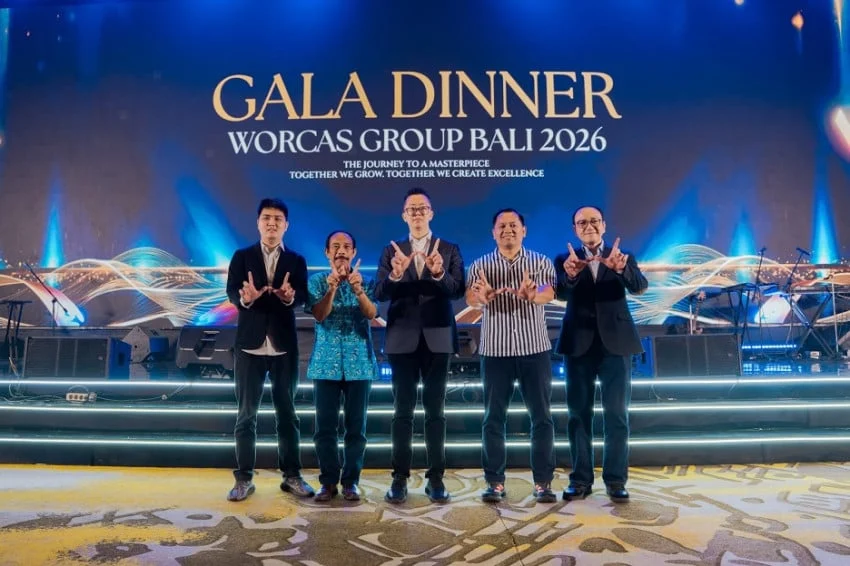
DENPARAS — Amidst the tranquil and picturesque coastal backdrop of the Meru Sanur Bali Beach Convention, the Worcas Group officially hosted its highly anticipated Gala Dinner Worcas Group Bali 2026 on Thursday, September 17, 2026. The landmark gathering brought together executives, stakeholders, international partners, and esteemed employees from across the conglomerate’s diverse operational sectors. Designed to celebrate both corporate resilience and future ambitions, the evening unfolded under the evocative theme, The Journey to a Masterpiece: Together We Grow, Together We Create Excellence.
For an enterprise that traces its foundational roots back to 1935, the 2026 gala served as much more than a routine corporate celebration. It functioned as a strategic milestone, highlighting a legacy spanning nearly a century of adaptation, economic shifts, and commercial expansion. Over the decades, the entity has successfully transitioned from its historical origins into a modern, multi-sector conglomerate wielding considerable influence across Indonesia’s commercial landscape. Today, the group manages a robust portfolio spanning structural construction, specialized corporate legal services, premium chocolate manufacturing, world-renowned artisanal civet coffee (kopi luwak), extensive retail networks, and critical healthcare manufacturing, including medical-grade protective face masks.
Strategic Vision and Executive Leadership
The evening’s formal proceedings commenced with an address by Roysevelt, Director of the Worcas Group, who took to the podium to reflect upon the organization’s historical trajectory and the human capital driving its ongoing success. Addressing an audience of hundreds of corporate leaders and operational personnel, Roysevelt emphasized that the conglomerate’s survival and sustained growth through numerous economic cycles are directly tied to its corporate culture of unity and relentless innovation.
"I invite the entire extended family of the Worcas Group to continuously safeguard our spirit of togetherness, strengthen our strategic collaborations, and collectively forge even greater milestones," Roysevelt stated during his keynote address. He underscored that as the company looks toward the horizon, maintaining internal synergy remains the primary catalyst for navigating increasingly competitive global markets.
Throughout his remarks, the director paid tribute to the dedication of the workforce, noting that the diverse business verticals under the Worcas umbrella—though operating in entirely different economic sectors—share a unified DNA rooted in quality assurance, customer-centric value creation, and long-term sustainability.
Showcasing Indonesia’s Finest: The Rise of Worcas Kopi Premium
A central highlight of the Gala Dinner was the formal presentation and sensory showcase of Worcas Kopi Premium, a product line that occupies a prestigious niche within the group’s expansive food and beverage division. Positioned under the bold and ambitious tagline, The Most Expensive Coffee in the World, the brand aims to elevate authentic Indonesian coffee culture onto the global stage.
The presentation provided attendees, including international trade delegates and retail distributors, with an immersive experience regarding the meticulous production processes behind Indonesian civet coffee. By combining traditional harvesting methods with modern quality control protocols, Worcas Kopi Premium seeks to capture the discerning palates of international luxury consumers. Industry analysts note that the global demand for ethically sourced, ultra-premium specialty coffee has surged steadily over the past decade, creating lucrative entry points for heritage brands capable of guaranteeing authenticity and traceability.
Beyond its beverage offerings, the spotlight also shone on the group’s high-end chocolate production lines, further reinforcing the conglomerate’s strategy to capture higher-margin segments of the consumer goods market both domestically and internationally.
A Century of Evolution: The Historical Chronology of Worcas Group
Understanding the scale and significance of the Bali 2026 Gala Dinner requires examining the chronological evolution of the Worcas Group. Established initially in 1935 during the colonial era, the enterprise began as a modest trading operation before progressively scaling its domestic footprint.
During its early decades, the company primarily navigated the archipelago’s agricultural and commodity trades. However, recognizing the shifting demands of a developing Indonesia post-independence, the leadership initiated a series of strategic diversification programs.
By the late 20th and early 21st centuries, the group had formally structured its operations into distinct corporate pillars. The construction division expanded to handle large-scale infrastructural and commercial real estate projects, capitalizing on Indonesia’s rapid urbanization. Concurrently, the establishment of the specialized corporate law firm division provided crucial internal and external advisory capabilities, ensuring that the conglomerate’s expansive commercial maneuvers remained fully compliant with evolving national and international regulatory frameworks.
The post-2010 era marked a period of aggressive retail and consumer goods expansion. The group successfully integrated its luxury food commodities—most notably its premium kopi luwak and artisanal chocolates—into high-end retail networks across major Indonesian metropolitan areas. Furthermore, the global health crises of the early 2020s prompted a rapid pivot into the healthcare sector, with the establishment of dedicated manufacturing facilities for medical equipment and protective face masks, demonstrating the group’s agility in responding to macroeconomic emergencies.
Diversified Portfolio: An Analysis of the Conglomerate’s Business Verticals
The multi-sector business model engineered by the Worcas Group offers a fascinating study in corporate risk mitigation and cross-industry synergy. By operating simultaneously in counter-cyclical and high-growth sectors, the conglomerate has built a resilient financial buffer capable of weathering localized market downturns.
-
Construction and Infrastructure: Acting as a foundational pillar of the group’s asset base, the construction sector capitalizes on Indonesia’s sustained infrastructural development boom. The division focuses on commercial buildings, structural engineering, and public-private partnerships, leveraging decades of project management expertise.
-
Corporate Legal Services: The inclusion of an in-house and affiliated law firm provides the group with a distinct competitive advantage. In an era of complex cross-border trade agreements and stringent domestic regulations, having specialized legal counsel embedded within the corporate ecosystem ensures rapid risk assessment and streamlined transactional execution.
-
Premium Food and Beverage (Kopi Luwak and Chocolates): Operating in the luxury consumer goods market, this division targets high-net-worth individuals and international gourmands. By branding products like Worcas Kopi Premium under elite global positioning strategies, the group captures lucrative margins that offset the volume-dependent nature of traditional agricultural commodities.
-
Retail Networks and Healthcare Products: The retail arm ensures direct-to-consumer market penetration, while the healthcare manufacturing division—specializing in medical supplies and protective gear—serves essential public health needs, aligning corporate profitability with national welfare objectives.
Economic Implications and Market Outlook
Financial analysts observing the trajectory of Indonesian conglomerates note that the strategic positioning displayed by the Worcas Group at the Bali 2026 event reflects a broader trend among legacy companies: the pivot toward global export readiness and premiumization.
As Indonesia consolidates its position as Southeast Asia’s largest economy, domestic enterprises are increasingly looking beyond national borders to sustain high growth rates. By leveraging events held in international tourism and business hubs like Bali, the Worcas Group effectively utilizes the island’s global visibility to court foreign investors, retail partners, and international distributors.
The emphasis on branding products such as Worcas Kopi Premium as world-class luxury items aligns with a growing global consumer preference for provenance, sustainability, and artisanal craftsmanship. If the conglomerate successfully executes its global retail expansion strategy, it could serve as a benchmark for how Indonesian heritage brands can successfully transition into international luxury markets without compromising their cultural roots.
Conclusion: Looking Toward the Future
As the Gala Dinner at The Meru Sanur Bali Beach Convention drew to a close, the prevailing sentiment among attendees was one of optimism and renewed purpose. The event successfully encapsulated nearly a century of institutional memory while charting a clear, ambitious course for the decades ahead.
Fueled by the foundational philosophy of Together We Grow, Together We Create Excellence, the Worcas Group stands poised at the intersection of tradition and modernity. With its diverse portfolio firing on all cylinders—from structural engineering and legal advisory to luxury agriculture and healthcare manufacturing—the conglomerate continues to solidify its standing as one of Indonesia’s most dynamic and enduring multi-business enterprises.